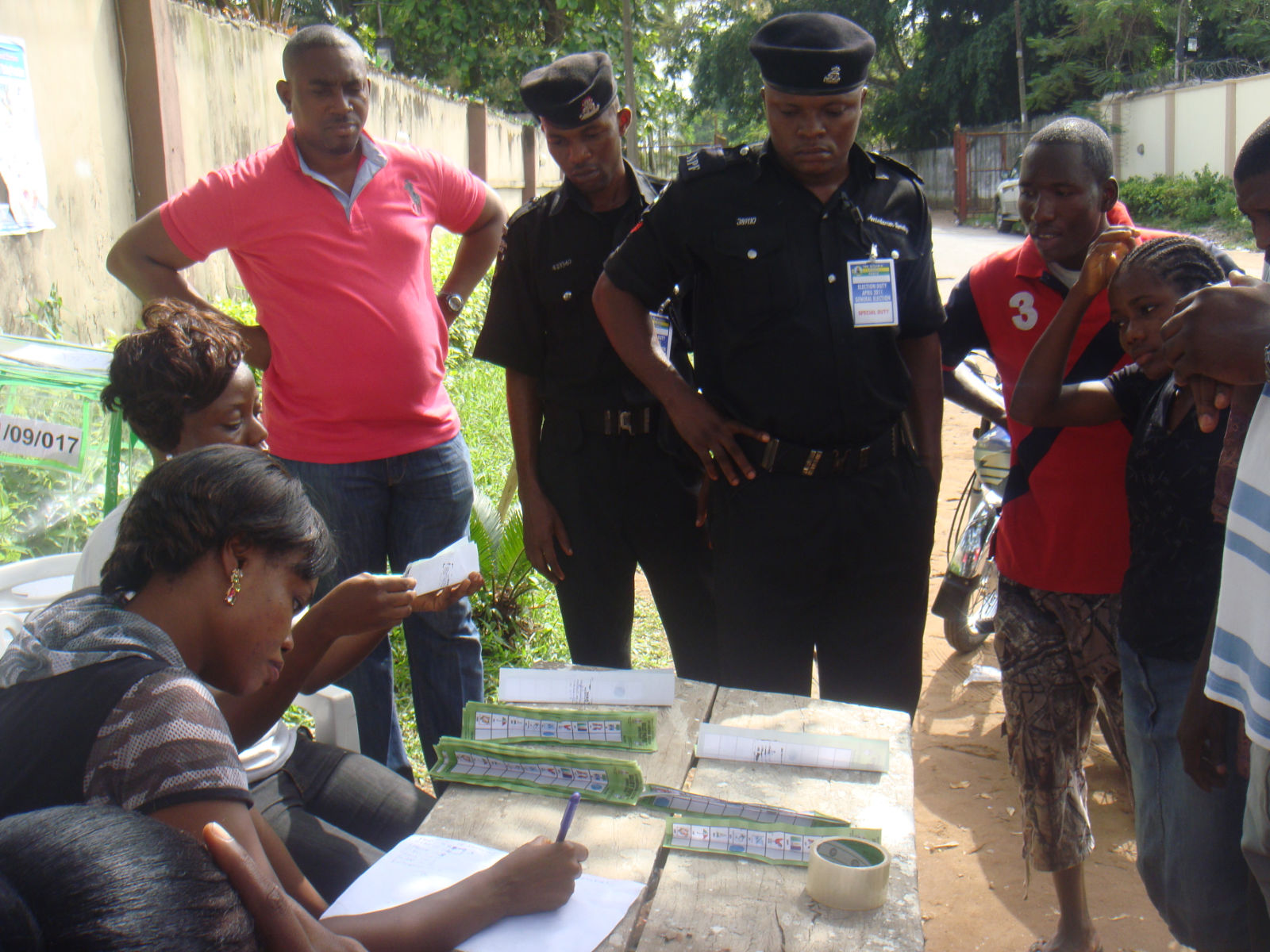
Let me start by saying that this Polling Unit (PU) should serve as a model for the whole of Nigeria. Despite the increased stakes, my eye witness reports that the INEC officials and Youth Corpers rose to the task. They were punctual, cheerful and willing to take suggestions from the voters. The voters themselves, though doubled from last week (173) managed to retain their sense of camaraderie. There were disputes but none strayed past words nor wandered into the pointless spiral of violence.
Even though the INEC supervisors and Youth Corpers, travelled in inferior style, they arrived bright and early with smiles on their faces.
 The requisitioned danfo bus used to transport the officials to their PU.
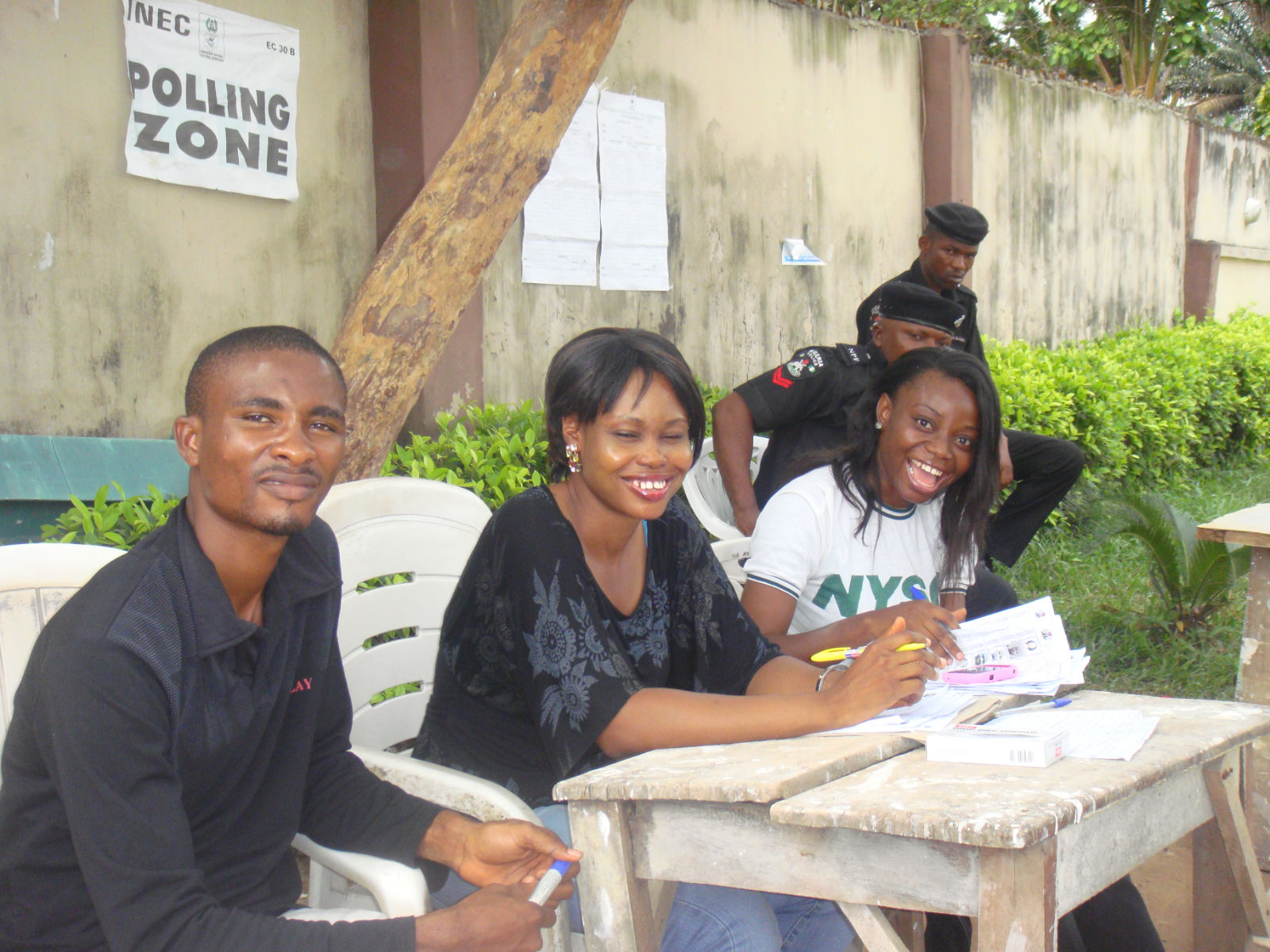 Here the corpers are ready at 8 am sharp to begin accreditation. Spot the funky corper from last week. Like every correct Lagos babe, her hair has changed. We'll see if she'll be sporting a new weave next week.
The party agents were also there, ready to ensure that their respective party candidates were not cheated of even a single vote.
 Each party sends a representative to as many PUs as possible to make sure that no electoral malpractice takes place. The cost of this precaution runs into the millions of dollars I've read. Hopefully, with credible elections, this money can be ploughed into campaigning and forming strategy rather than 'protecting votes' which a functioning system would do.
Accreditation went on in a relaxed manner that lent an informal tinge to the affair. Again between the hours of 8am and 12 noon, voters came with their voting cards to have their thumbs marked.

During accreditation, an elderstateswoman (more on this) pointed out to the INEC supervisor that though a poster urged voters to call HOTLINES with complaints, no numbers had been given.
 Note the blank space under HOTLINES. I wonder how the person who pasted this missed the error.
 The problem was reported to this INEC supervisor,
 And the matter was immediately rectified. Democracy in action.
During accreditation, a car load of women pulled up at the PU. They were driven there by a man in a blue shirt. They too, no matter the stares and insults cast at them, had come to cast their votes and choose who they wanted to be president.

After accreditation the voting process began. Last week at this PU, they had waited till 3pm to start casting votes but this Saturday, voters started queuing from 12.30pm.
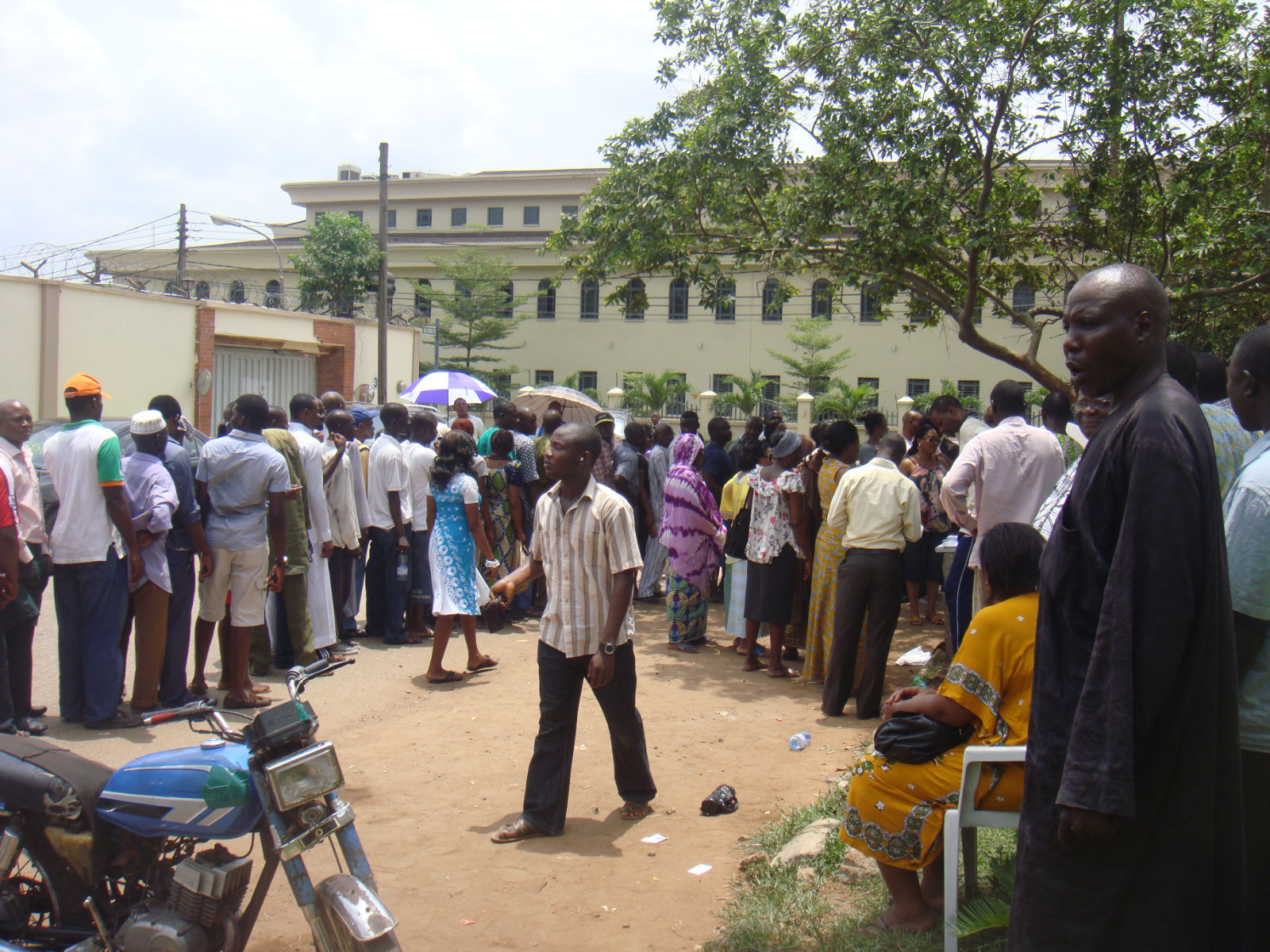
The sun was terrifically, stupendously hot. One voter at a Maryland PU said, "who needs a sauna when you have elections." Anti-PDP campaigners sent out texts this morning saying, 'there's no rain today so there's no need to vote for umbrella' (the PDP symbol). In Nigeria however, we use umbrellas not only to shield us from rain but also to protect us from the sun, as demonstrated at this PU.
 Negative campaigning proving to be mistaken.
Like last week, the same woman who translated the instructions into Hausa was on hand to do so again.
 It seems that the NASS elections and results have given people faith in the electoral process. Not only were last week's voters present, more came to swell their ranks. Kudos to Jega for restoring hope in a broken system.
The international observers came along to watch quietly.
 Their name tags stated they were sent by the British High Commission but many believed that the man was in fact an Igbo man (methinks of the name of Chukwudi or Ikenna) and the lady hailed from somwhere in Egba land (a Titi or a Derin).
 The name tags that marked them out.
Some soldiers also cruised by to make sure nothing criminal, like the stealing of ballot boxes, was taking place at this PU.
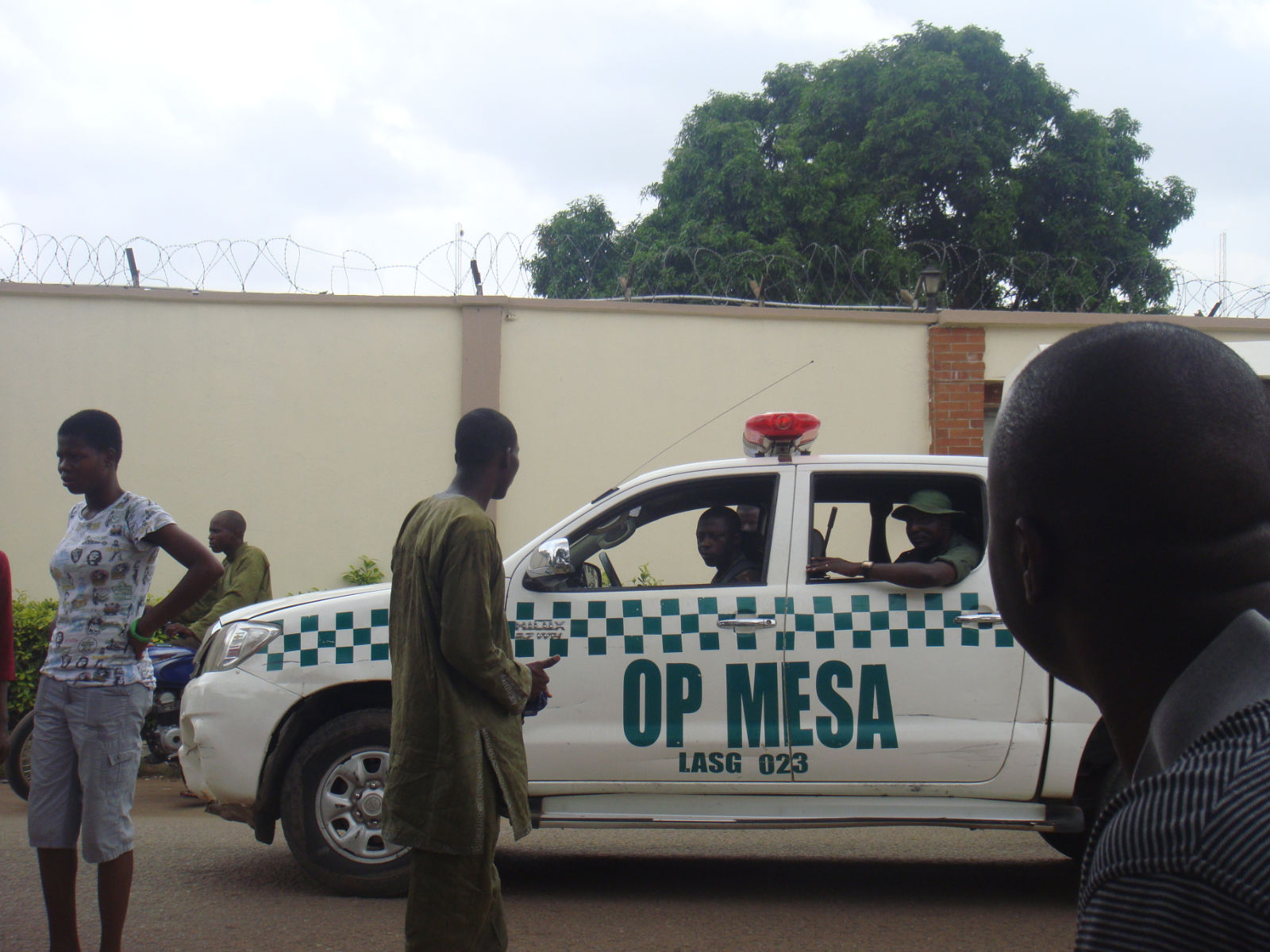
Not all the soldiers however, were interested in the process of peacefully and democratically electing a President.
 Spot the sleeping soldier.
While the voters queued, some Lagosians saw their presence as an opportunity for economic advancement. They were looking for a more immediate and tangible change from the election process.

Whilst voting was taking place, the INEC Observers also showed up, in vastly superior style to their subordinate supervisors and corpers.
 What the significance of Rolypoly is I cannot guess at. I'm not very good with cars so I don't know what make this is. Any suggestions? I do know however that this car looks expensive. Compare it with the chariot of the lower cadres.
Again, an elderstateswoman (more on this soon) suggested to the INEC supervisor, that instead of going to the polling booth one by one (as had previously been done), two ink pots should be provided so voters could decide on both sides of the booth. The suggestion was taken on board and applied to immediate effect.
 Single voting at the booth. Note the sense of awe as the man walks slowly to the private session. One eye witness described this scene as a voter 'approaching the altar of democracy.'
 Double voting at the booth. Democracy in action.
What with party agents, INEC supervisors, army officials, international observers and INEC Observers all gluing their eyes to the clear transparent box, there was no chance for hanky panky. Some voters, who lived nearby and could not stand the burning heat decided to go home and return before 4pm when voting would close. After all, they were sure the ballot box would not be missing when they returned.
In a Lekki P.U, residents had, had the foresight to rent a canopy for queuing under.
 In all P.U's in Lagos, elderstatespeople and pregnant women were given priority and allowed to vote first. In Nigeria and in most parts of West Africa, there is a culture of respect for elders and we generally don't wait for someone to be in their eighties to accord them the status of elder. Thus voters still in their fifties were granted the status of elederstatespeople. They were physically able to stand under the sun like most of their younger counterparts but culture dictated that they should be given priority. Democracy is a Western process but in its execution, I am glad to see that our culture has not been forgotten. That is the only way this thing will survive, if we graft our own ways and practices into it.
For those who were neither elderstatepeople nor pregnant (though some feigned the latter to escape the queue), if they lived closeby, they went home.
At around 3pm, the first of those who had gone away returned, a poor man. While he had been away, trouble had been brewing. One voter at 2.30pm decided that the ballot should be counted though 15 accredited people had still not cast their votes. In other PUs counting had begun and he was eager to start the process.

Here he is on the phone to an officer superior to the INEC supervisor posted to this PU. The man had connections and he was prepared to use them to get his way. The poor man who had returned before the agreed time of 4pm was sent away and told he could not vote because the votes were ready to be counted. However, a more affluent member of the 15 remaining accredited voters arrived to fight for their cause.
 As an eye witness reports, he [the man in the brown pinstripe] 'refused to be disenfranchised.' He had returned before 4pm and he must cast his vote. After a lot of clamouring, it was agreed he would vote and the poor man was recalled to do the same. Democracy in action.
Despite this, 7 accredited voters still had not voted by 4pm when the polls were closed.
 The full ballot box.
Voters are shown the ballot with a thumb print on it, before they are arranged into piles.
 The trendy corper holding up the ballot is showing signs of fatigue. It had been a long day.
 The ballots being divided into party. The small pile closest to the onlookers were votes that were void because voters had not placed their thumb prints correctly. Another pile was given to votes where the question of it they were void or not was more difficult to decide.
 A photograph of a successfully cast vote from a Lekki PU.
Problems arose however, when debate sparked over if a vote was successfully cast or not.
 Voters arguing that a vote which had been declared void was actually for X party.
They became so vocal in their protests that the trendy corper lost her calm and asked for the police to intervene.
 A Nigerian policeman stepping up to the task and warding the voters back from the counting desk. The man in the yellow shirt is our blackberry journalist from last week. He isn't videoing this time but he stayed to watch the counting of the votes and again bought water to encourage others to stay. Enough is Enough.
The ballots were placed into their separate piles and the trendy corper showed the voters that she had not hidden any ballot papers in her pockets.
 Clearly those jeans are too fitted for any ballot papers to be stuffed therein but the newly awakened Nigerian voter must be satifisfied. He/she is taking no nonsense.
The votes were then counted. The voters joined in the process counting out loud as each vote was tallied. And finally the day was was done.
 The votes being counted under watchful eyes.
The trendy corper packing her belongings into her equally trendy Nigerian flag briefcase.

Behind her, the results are being texted, tweeted, or emailed all around the world.
The results were pasted on the wall behind the PU.
 As you can see, each party agent must sign to show that they were happy with the way elections were carried out and they did not feel cheated by the process. Democracy in action.
PDP carried the day at this PU with 82 votes. CPC followed with 57 and ACN trailed behind with 14. Also, note how many parties are listed on this sheet. Who in Nigeria has heard of the FRESH party? Out of 833 voters who registered at this PU, 173 were accredited, and 165 actually voted. Turn out was more than double last weeks pitiful show of 72 but still not as high as I would have liked. Yet those that came out to vote, came out with verve and gusto to see their rights carried out.
And at this small polling unit in Lagos, whether rain or shine, the majority opted for the Umbrella. Join us again next week for reports from the friendliest polling station in the world and other polling booths around Lagos. Many thanks to our eye witness in G.R.A, Maryland and Lekki. My name is Chibundu Onuzo. God bless and goodnight.