Here's a piece I wrote for the Guardian comment is free about Boko Haram and Nigeria. Read it here.
Tuesday, 26 June 2012

Monday, 18 June 2012
Rare Rising Stars
 |
| With Idris Bello (a fellow Nigerian who was on the list for his social enterprise) |
I was fortunate enough to be on Rare Recruitment's list of the top ten black students in the UK. In fact, I was number one :) We thank God. The awards were held at parliament and I had a really lovely time. Visit the Rare Rising Stars website for more about the event, the other stars and pictures.
Thursday, 31 May 2012
Interview on Bellanaija

Please tell us a bit about yourself – what you do; your education and where you grew up.
My full name is Imachibundu Oluwadara Onuzo – Oluwadara because my mother is Yoruba; Imachibundu because my father is Igbo. I grew up in a very quiet estate in Lagos. I know almost all my neighbours by name and in turn most of them know me as ‘one of Dr. Onuzo’s daughters.’ Both my parents are doctors and are still practising. My primary school was called Corona Gbagada. Our school anthem described us as ‘the centre of excellence’ a motto borrowed from my much beloved Lagos State. I then proceeded to Atlantic Hall where once a week we sang lustily, ‘We love thee o, Great Atlantic Hall.’ It was perhaps an attempt by the anthem writer to brainwash us unruly adolescents. After three years at ‘A-Hall’ as her alumni call her, I went to St. Swithuns, a school in Winchester, where I perfected my phonetics and shortened my name to ‘Chibs.’ I then went to University in London, King’s College, where I dropped my phonetics and lengthened my name once more to Chibundu. Now, on the cusp of graduation, as I prepare for the next phase in my life; perhaps, I will assume the name of Dara.
Read the rest here.
Wednesday, 16 May 2012

Thursday, 26 April 2012
Boko Haram and Nigeria

A police chief once said that he hoped Boko Haram would soon run out of fools to blow up. He said so in that characteristic way in which we Nigerians vent our frustration by telling slightly tasteless jokes. Black humour always come to our rescue. Under Abacha we joked. During Occupy Nigeria, even as bullets strayed into the crowd, we joked. And this police chief, confronted with the ineptitude of his force and the foreignness of the mode of attack (but Nigerians love life too much to be suicide bombers), he too he joked. The bombing of schools, churches, mosques, UN buildings, police headquarters, it is not a laughing matter, yet still we joke and I think in the end, it is this that will save us.
Boko Haram is not strong enough to overwhelm Nigeria with force. They have neither the arms nor the funds to stage a military invasion of Nigeria. So what we have instead is a war of attrition. They strike here, strike there and hope that they will wear us down. I have not yet seen the power or calamity or disaster that is capable of wearing the Nigerian down. We can be angered, we can be pained, we can suffer but tomorrow we rise at 4am, rinse our faces and we start again. Not in an automated, mechanic way but in a matter of fact, practical way. And when the pressure builds we fight. And when, that is not enough, we burn each others houses. And if still, all is not released, we will kill each other. But then we start again and all the while, while we fight and burn and kill and die because the hospital had no drip and the road was not tarred and the light was not working, all the while, we joke. And then we start again not in an automated, mechanic way but in matter of fact, practical way.
This is what suffering has done to us. Perhaps it has made us easily trampled on. Sparks that would ignite a population elsewhere, soon flicker out. Forest fires that would explode another country, flare briefly and die away. Yet, this suffering has also made us very difficult to wear out. In a war of attrition, I will bet on Nigeria every time.
My hope for my country is that we learn to get angry in a constructive way; we learn the angers that builds roads and schools and credible elections and power plants and an honest police force. But I also hope that when finally, the people are aroused, we will not forget how to deal with suffering. It is not to be crumbled in front of, nor cowed by but to be joked at. And when it has done its worst, we start again, not in an automated, mechanic way but in a matter of fact, practical way.
May the souls of all those murdered by Boko Haram today rest in peace.
Tuesday, 24 April 2012
SKD Longlisted for the 2012 Desmond Elliott Prize

The Spider King's Daughter has been longlisted for the 2012 Desmond Elliott Prize. It's for debut authors published in the UK and I'm well pleased. We thank God. For the rest of the longlist, click here. I'm in very good company. :)
Saturday, 21 April 2012
Once Upon a Time

I stumbled across this beautiful poem on the internet by the Nigerian poet called Gabriel Okara. His book, 'The Voice,' has gone straight onto my to be read list. Anyways, here's the poem.
Once Upon a Time
Once upon a time, son,they used to laugh with their hearts
and laugh with their eyes:
but now they only laugh with their teeth,
while their ice-block-cold eyes
search behind my shadow.
There was a time indeed
they used to shake hands with their hearts:
but that’s gone, son.
Now they shake hands without hearts
while their left hands search
my empty pockets.
‘Feel at home!’ ‘Come again’:
they say, and when I come
again and feel
at home, once, twice,
there will be no thrice-
for then I find doors shut on me.
So I have learned many things, son.
I have learned to wear many faces
like dresses – homeface,
officeface, streetface, hostface,
cocktailface, with all their conforming smiles
like a fixed portrait smile.
And I have learned too
to laugh with only my teeth
and shake hands without my heart.
I have also learned to say,’Goodbye’,
when I mean ‘Good-riddance’:
to say ‘Glad to meet you’,
without being glad; and to say ‘It’s been
nice talking to you’, after being bored.
But believe me, son.
I want to be what I used to be
when I was like you. I want
to unlearn all these muting things.
Most of all, I want to relearn
how to laugh, for my laugh in the mirror
shows only my teeth like a snake’s bare fangs!
So show me, son,
how to laugh; show me how
I used to laugh and smile
once upon a time when I was like you.
Gabriel Okara
Monday, 9 April 2012
Book Launch!

It was on Monday March 19th and I had a wonderful, wonderful time. It was hosted by my university, King's College London. They've been ever so supportive. First they put me on the cover of the alumni magazine, then they organised my first reading and now the launch. Big up to Kings! My sister took a thousand and one pictures but I'll only put a few up here.
 |
| My cousin Opeyemi who was an excellent MC. She came straight from work as well, instantly slipping from corporate high flyer to relaxed MC. |
 |
| Ellah Allfrey, Deputy Editor of Granta, who asked me some questions about the book that challenged me I must say. Also, I look like a giant in this picture. |
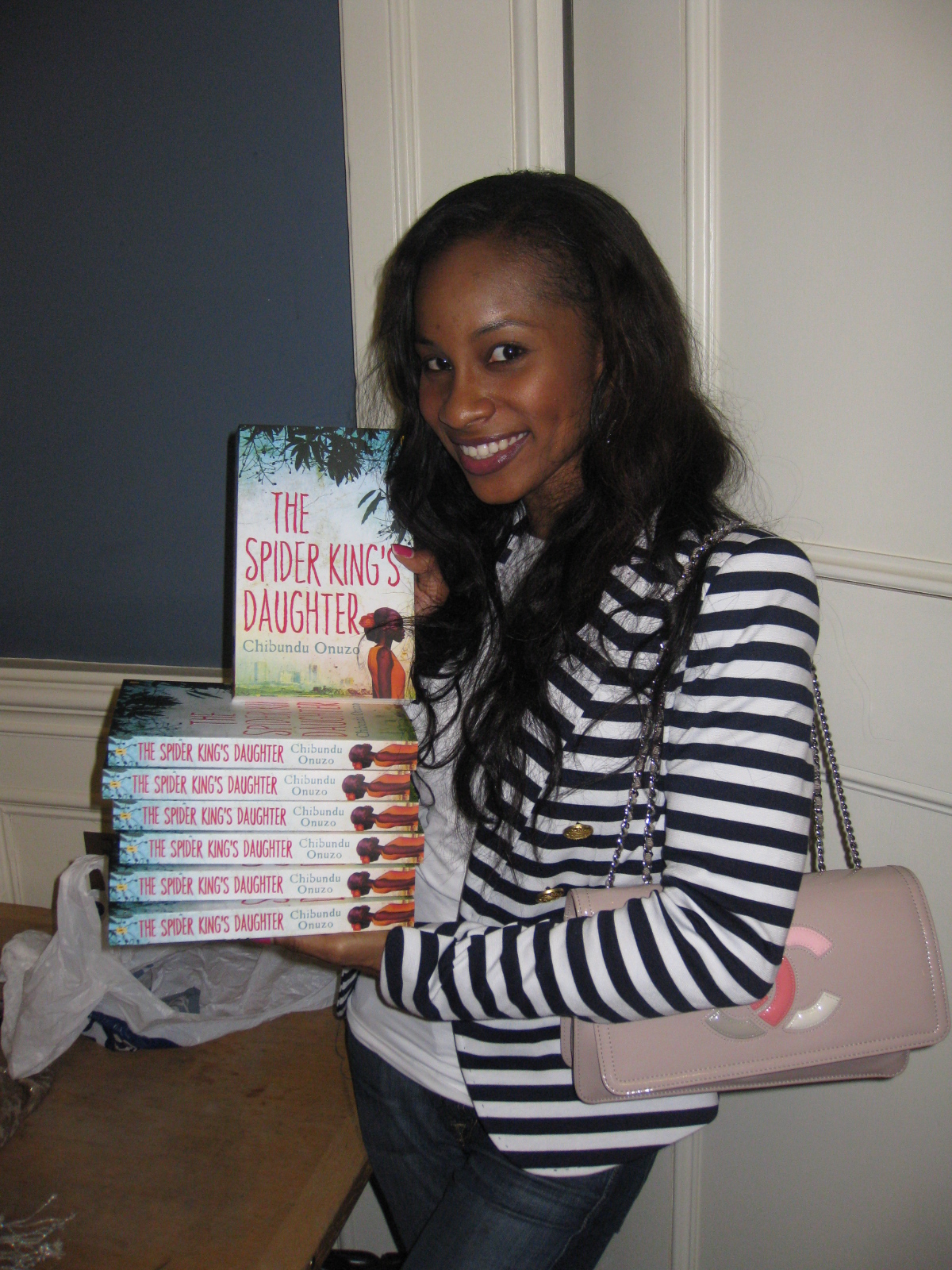 |
| My friend Jibs, with her pile of books. |
 |
| Girls are smiling. |
 |
| I promise I don't know them :) |
PS
I've put more photos on my fanpage album.
Sunday, 1 April 2012
E ma Binu

The title of this post, when roughly translated from the Yoruba to the English means, 'don't be angry.'
There are few things more unpleasant than a writer who only blogs to promote their books and has nothing to say but buy my book, read my reviews, like my fanpage. So e ma binu.
I've been very busy though. One 10,000 word essay just handed in on Friday, a 5,000 due in 22 days and another 10,000 to be done before the month runs out. If you think this is scanty excuse, e ma binu.
And of course the novel just came out. Southbank, Radio 3, Oxford Literary Festival, World Service, Black Book Swap, I've gone to all these places talking about my book and hoping to find new readers. They've all been wonderful and I've enjoyed them so much but sadly they've not left much time for blogging. So please, e ma binu.
And then we have the finals. May 18, the last exam I'll ever write as an undergraduate student and now less than two months away.
So in the meantime, please buy my book, read my reviews and like my fanpage and as you do, ejo o, e ma binu.
Monday, 26 March 2012
Join me at SOAS this Thursday

I'll be in SOAS on the 29th of March from 6-8pm discussing my book with Ore Disu and Tricia Wombell.
The full venue address is Khalili Lecture Theatre, SOAS, Brunei Gallery, Thornhaugh St, Russell Square, London, WC1 H0XG.
The nearest tube station is Russell Square on the Picadilly Line.
Full details are here.
Also, a review in the FT. Read here.
And I've uploaded some pictures and reviews I can't post here to my facebook fan page here.
Friday, 23 March 2012
Tabia Princewill Speaks

Musings of a frustrated Corper
To face up to the glaring deficiencies of the dinosaur we call NYSC, government needs to implement more than surface reforms. For many today, NYSC is an ordeal; a necessary evil; a rite of passage whereby one learns to adapt to the flawed codes of conduct in our society. Indeed, NYSC is a foray into the real world which ideally should teach best practices and attitudes conducive to our development and progress as a country. Ironically, the scheme in its current configuration does quite the opposite.
Corpers are regarded as cheap labour by the organisations who employ them and one very often spends the service year running errands, some highly degrading others simply pointless and non relevant to the job at hand. There is no obligation for the corporate world or even the public sector for that matter, to train the corpers they take on. Rather, youth service becomes a sort of demeaning servitude. Let us speak plainly about the real issues at stake and go beyond surface reforms: female corps members are harassed not because they have no martial arts training (contrary to what proposed reforms would have us believe) but because there is little to protect them from sometimes predatory and unwanted attention. Their inability to mimic Karate masters is irrelevant. It is the very philosophy of NYSC, the unequal relationships between corpers and their would be co-workers that is the problem.
Different sets of rules apply for individuals depending on their class, social status or occupation. Corpers, hard working graduates called to serve their country, are perceived as being at the very bottom of the social pyramid rather than the nation’s pride. So they are ridiculed and taken advantage of. Despite the present reforms there is still nothing to protect corps members as concurrently there is no social security net to protect the poor, the elderly and the weak in our society. NYSC currently is an exercise in adaptation to the functioning of a dysfunctional society: a way of learning in practical terms about inequality and injustice.
So what is the point of NYSC? Beyond the objective of national integration, what is a corper meant to gain at the end of his or her service year beyond an often thoroughly degrading and sometimes even traumatizing experience where girls face the lewd advances of men in a position of power and young men are frustrated and angered by the fact that after being used in all sorts of ways, most companies will not retain them? Our government asks Nigerians to love their country, serve it with all their heart and mind, respect their leaders and the laws of the land but gives nothing or little in return. No modern society is based on such unequal dealings. The National Youth Service Corps must provide young people with a career path, a set of skills from which they can earn a living. This should be the core requirement of the scheme, a key term of the contract between the Federal Government and all organisations in both the private and public domain.
NYSC can not be a success, will not add value to both corpers and organisations if there is no training process or clearly defined tasks for corpers to undertake during their service year. As for being retained, so few companies do. This should not be so. Abroad, many organisations hire interns for the year and review their performance at the end of said year. It is impossible to offer a job to everyone, but it is unheard of to offer a job to virtually no one besides the children of those who have family or friends in the organization. As for corpers in the public sector, for them too there should be the possibility of a career path beyond NYSC.
The current reformist idea is to post corpers mostly to rural areas in dire need of the manpower to develop these communities. The problem here is that corpers are regarded as ‘manpower’ and not as individuals with dreams and aspirations and who deserve, just like anyone else, to have a fighting chance at achieving their potential. Should corpers pay for the inefficiencies of governments who were not able to develop rural areas? Serious reform is not to decide that corpers should solely be posted to rural areas where they can serve their country as teachers and doctors when they might have no desire, interest or more importantly ability to do so, thus creating another generation of dissatisfied Nigerians who take out their frustrations on the future youths they encounter!
The path to real reform is to ensure that corpers in different sectors are properly trained for a job and acquire skills and prospects. A nation which fails the youth by its inability to provide them with a decent future is surely failing in its developmental objectives. I would also like to remind government that “without debate, without criticism, no administration and no country can succeed and no republic can survive” (John F. Kennedy) so rather than believe criticism to be the work of enemies, real, spiritual and imagined I would like to urge government to act. As the grunt of Nigerians continues to suffer government’s inaction in silence, as some members of society respond to their frustrations through violence, one can only hope that we are all able to rise to the responsibility and challenge of creating a better Nigeria.
Tabia Princewill
Tabia Princewill is currently a corper in Lagos.
Wednesday, 21 March 2012
Blog for the Thought Fox

Read the rest here.

Also, I'll be at the Southbank tomorrow with Noo Saro Wiwa tomorrow.. Join us if you can. More details here.
Sunday, 11 March 2012
BBC Radio Scotland

Friday, 9 March 2012
Short Story on Radio 3!

My reading of my short story Easter Sunday will be on Radio 3's Verb tonight at 10 pm. To listen live online click here or do it the old fashioned way and tune in on your radio.
Wednesday, 7 March 2012
N.E.P.A

Growing up, many evenings and nights were spent in darkness. I did not mind too much when the power was cut off in the afternoon. Though the house became dim, there was still enough light to read and play Ludo and hopscotch. It was around 6pm when N.E.P.A had still not brought light that the absence of electricity became annoying. There were candles but reading by candle light had been embargoed by my mother for fear we would be partially blind before we reached our teenage years. So between 7pm when we ate and 9- 10pm when we slept, there was a lot of time to kill.
Sometimes we played with fire. This could take up a good half hour. We started by running our fingers through the candle flame. There was no winner in this game but the slower you passed your finger through the flame, the more of a pro you were. If you ran your finger through very quickly, you didn't feel anything and chicken that I was, I always took this option. Also, there was the two finger candle game where you tried to put out the flame by pinching it between your thumb and your index finger. I never attempted this round but some of the maids would show off by putting out the flame in this fashion. Then of course there was the candle wax game, which entailed spilling the molten wax on your hands and then scraping it off when it cooled.
However, my personal favourite was the matches game. You took a match, held it to the flame and let it catch fire. You then held it for as long as you possibly could. The further down the match the flame burned, the more proficient you were at this game. One of my proudest moments was when I managed to burn the whole match stick, right from its sulfuric head to its wooden stump. Usually, I could only burn the match for a few seconds before the heat got too close to my fingers and I dropped it. Then one day, I realised that if I held the charred end, I could burn the whole match with ease. After I'd beaten the system, I grew tired of the match game.
I tell this story because over the weekend I went to a seafood restaurant which was mostly lit by candle light. And it wasn't any of those fancy scented candles but the thick, white wax ones that I grew up with it. Of course, we began playing with the flame. I would break off pieces of wax and liquidize them in the blue part of the flame. I would spill the melted wax down the side of the candle. My friend opposite me even ran her finger through, a feat I found I no longer had the liver for. I don't know how but at some point, I tipped the candle too far and the molten wax that builds up under the flame spilled onto the back of my hand. I flinched but to my surprise I was able to chest the pain and even enjoyed scraping the wax off when it hardened.
After we got tired of playing with the flames, we made shadow puppets. I wasn't very good at this, my fingers are quite clumsy, but my cousins could do some wonderful shapes. I never progressed past the perfunctory butterfly but others could act out complete dramas on the walls. When we tired off puppets, we moved to singing. I played the piano, my sister would drum on our much bruised dining table and we would all sing, soprano, alto and tenor. I can still play with my eyes closed because of this training in the half light of the candles.
Sometimes we would go to bed without them having brought light. Other times the light would come suddenly, mid-song. The electricity would startle us, our eyes would squint at the artificial brightness of it and the flame would suddenly lose its magic. "Up NEPA!" we would shout but we didn't mean it entirely. We had been enjoying the camaraderie of the candle. With electricity there was no excuse for sitting together and singing. To switch off all the lights and continue making shadow puppets would be foolish when work clothes had to be ironed. And why play with wax when you could watch TV. So we would disperse until the next time NEPA had not brought light by evening and there was not enough diesel to power the generator.
A few months ago I was in America during a storm and the power was cut off. In the evening, candles were lit all over the house that only a day before had consumed an entire village's supply of electricity. It was my favourite night of the trip. This is how things should be sometimes, I thought as I played my uncle's piano with my eyes closed. This is how it should be.
Subscribe to:
Posts (Atom)
