
Showing posts with label African Literature. Show all posts
Showing posts with label African Literature. Show all posts
Wednesday, 30 November 2016

Monday, 22 June 2015
My Favourite Books of 2013

I read about Molara Wood’s ‘Indigo’ on twitter. She was very
discreet, tweeting in passing that her short story collection was out without
even urging us to ‘grab our copies!!!’ Nevertheless, I hurried to Amazon and downloaded
the book. I’ve never encountered Ms Wood’s fiction before and so I approached
with curiosity. It can take me months to read a collection. I hate the
unevenness of the things. You read a brilliant story, only for you to rush to
the next one and discover it’s a dud. Ms Wood has no duds. Obviously, all
fingers being unequal, some stories are more brilliant than others. ‘Night
Market’ which has the unlikely ingredients of an ex-Sango priest, an American
wife and a returnee, is one of the most satisfactory pieces of fiction I have
read, a world in a short story. It was so complete, I wondered why any writer
wastes paper on a novel?
And then of course Igoni Barrett’s ‘Love is Power orSomething Like That.’ I found the title a bit unwieldy and I wondered why in a
collection of delightful numbers such as, ‘My Smelling Mouth Problem’ and, ‘The
Shape of A Full Circle’ Barrett and his publishers should have chosen such an
amala bolus of a title. Well I read it and discovered why. I found myself
chastised by this very nuanced portrayal of that oft caricatured individual:
the Nigerian policeman. It’s a fluid piece of fiction that slips into your
consciousness and remains there long after it is over. Barrett is also doing
something very interesting with language. He’s writing in Nigerian English, not
pidgin, which Eghosa Imasuen, does with flair but in Nigerian English: that
curious, convoluted, verbose, ungrammatical, profound, lyrical way we have of
speaking ‘English’ to one another.
Lastly, the discovery of the year for me was the Congolese French
writer, Alain Mabanckou. His semi-autobiographical novel, ‘Tomorrow I’ll Be
Twenty’ may very well become the definitive coming of age tale of a generation.
Communism, dictators, coups and suspect diamonds all feature in what still
remains a very funny novel, thanks to the earnest lens through which the young
narrator sees the world. I read the book to the end and so saddened was I by
how quickly I’d consumed it, I went back to the beginning and started again. It
was that good. These four books I’ve mentioned are that good. So grab a copy of
each one. Grab your copies now!
First published on YNaija.
Thursday, 22 August 2013
My Ghana Trip on CNN
.JPG)
'With only a 45 minute flight separating Lagos and Accra, you'd think I'd have been to Ghana at least once in my 22-year existence. Unfortunately until July 2013, the concepts holiday and Africa have never gone together in my head.
Holiday was Italy and structurally unsound towers; or America and discount shopping or France and baguettes. Not Ghana, longstanding "frenemy "of Nigeria, with the football team we all rooted for in the last World Cup. Yet, that's no reason to actually visit the place.'
Read the rest here. Also below is the promo video we did for the tour which for some reason I forgot to post here.
Sunday, 18 August 2013
Telephone Conversation

I read Wole Soyinka’s poem, Telephone Conversation when I
was fourteen. I liked it so much I made it the desktop background on my laptop.
Each time I turned on this shiny new device, I would read the words, ‘The price
seemed reasonable, location indifferent. The landlady swore she lived off
premises.’ The poem struck me. Perhaps it was because I was in an English
boarding school, discovering for the first time my ‘blackness.’
‘How dark?’ Soyinka ‘s landlady asked the character who I assumed
was Soyinka himself. ‘Facially, I’m brunette.’ Facially I was... I had never
stopped to consider. I was Nigerian. My classmates, sensitive to but ignorant
of the nature of my dislocation, would sometimes say as if in reassurance, ‘I
think black people are cool.’ Why are you telling me, I would wonder but never
ask?
My spine weakened a little when I moved to England.
Confident, boisterous, perhaps overbearing in Nigeria, I became unsure in England:
unsure of my accent, unsure of the value of what I knew, flabbergasted by my
ignorance of Jack Wills and lacrosse. Soyinka’s poem put some calcium back in
my bones. Every time my eyes wandered to
the bottom of the screen and read, ‘Friction, caused- foolishly, madam- by
sitting down, has turned my bottom raven black,’ I would shake with laughter,
the punch line new again. A new country was to be met with this verve, this
panache, this style, this trademark Soyinka wit. No apologies for where I was coming
from. None at all.
 |
| A young Soyinka, harassed by landladies. |
Telephone Conversation
Wole Soyinka The price seemed reasonable, location
Indifferent. The landlady swore she lived
Off premises. Nothing remained
But self-confession. “Madam,” I warned,
5 “I hate a wasted journey—I am African.”
Silence. Silenced transmission of
Pressurized good-breeding. Voice, when it came,
Lipstick coated, long gold-rolled
Cigarette-holder pipped. Caught I was, foully.
10 “HOW DARK?” . . . I had not misheard . . . “ARE YOU LIGHT
OR VERY DARK?” Button B. Button A. Stench
Of rancid breath of public hide-and-speak.
Red booth. Red pillar-box. Red double-tiered
Omnibus squelching tar. It was real! Shamed
15 By ill-mannered silence, surrender
Pushed dumbfoundment to beg simplification.
Considerate she was, varying the emphasis—
“ARE YOU DARK? OR VERY LIGHT?” Revelation came.
“You mean—like plain or milk chocolate?”
20 Her assent was clinical, crushing in its light
Impersonality. Rapidly, wavelength adjusted,
I chose. “West African sepia”—and as an afterthought,
“Down in my passport.” Silence for spectroscopic
Flight of fancy, till truthfulness clanged her accent
25 Hard on the mouthpiece. “WHAT’S THAT?” conceding,
“DON’T KNOW WHAT THAT IS.” “Like brunette.”
“THAT’S DARK, ISN’T IT?” “Not altogether.
Facially, I am brunette, but madam, you should see
The rest of me. Palm of my hand, soles of my feet
30 Are a peroxide blonde. Friction, caused—
Foolishly, madam—by sitting down, has turned
My bottom raven black—One moment madam!”—sensing
Her receiver rearing on the thunderclap
About my ears—“Madam,” I pleaded, “wouldn’t you rather
35 See for yourself?”
Saturday, 10 August 2013
Tribute to Chinua Achebe
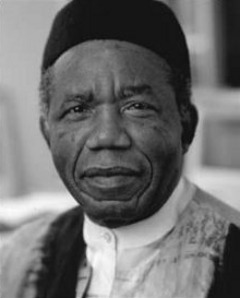
For me, “Things Fall Apart” was just a novel. I came to it
with no baggage, my shoulders unweighted by the colonial portmanteau of my
parent’s generation, my mind decolonised and unintimidated by crinolines, English
accents and bread and butter pudding. At fifteen, I read the novel in one
sitting. Okonkowo threw Amalinze in my bedroom, murdered Ikemefuna in my
kitchen and rather bathetically, swung from a tree in my toilet, oblivious to
my sister’s knocking and shouting, “Chibundu come out. I need the bathroom.”
I had been running away from ‘Thing’s Fall Apart’ for many
years. Its reputation preceded it, outdistanced it, ruined it in my opinion. A
book about which there was so much hype could not but disappoint. And so I
walked past Achebe whenever I saw him on a shelf until I reached that age when
I started reading certain books because you ‘had to read them.’ Certain
Victorian novelists, or certain Nobel Laureates, or certain ‘masters of the
form.’ I would trudge through pages of text, understanding little, glad to
finally reach the end so I could say, ‘Oh I’ve read so and so.’ Thus I came to
Chinua Achebe as one would come to some traditional rite of passage. Not
particularly enjoyable but you had to get on with it.
And then I read it
and realised that Things Fall Apart was that rare and wonderful thing: a book
that needed no reputation. The author’s background was irrelevant, his awards
and accolades and sales figures and reviews and book club listings and Amazon
rankings, all this was immaterial. All you
needed to do was pick up Things Fall Apart as a novel, just a novel, nothing
more, nothing less and it would deliver on that. Save context for a second
reading.
Yet, for those like my parents who lived closer to the
slights and condescensions of imperialism, Things Fall Apart could never be
just a novel. I asked my father what the book meant to him. The distance
between my father and I is not just one of age or generation. Coups, pogroms,
civil wars, structural adjustment programmes, Festac 77, wars against
indiscipline, first republics, second republics, Federal Republics, Federal
Democratic Republics: all these lie between my father and myself. For him, Things
Fall Apart was bound up with identity. ‘He showed the good. He showed the bad.’
That was how my father put his thoughts. There were good things in Igbo culture
before colonialism came and there were bad things. Just like in any society, in
any culture, in any civilization. For a generation like my fathers, that had to
prove that they were as good as, as smart as, as human as, Things Fall Apart
was seminal.
It’s a privilege to be able to put aside the context of
Achebe’s work if I so choose and revel in nothing more than the words on the
page. Yet I salute him for what he meant to a generation, the confidence he
added to their stride and the assurance he gave them about their past. And then
I salute him again, for what he did for many African writers, the inspiration
he gave us, the doors he opened, into publishing houses and into the recesses
of our imagination, as we drew on images and stories that we once thought bush,
boring and unsophisticated. And finally, I salute Chinua Achebe, for what he
meant and will mean to the world. For when those readers who understood the
context of his times are long dead and when their children are long dead, there
will still be those who will delight in the throwing of Amalinze and weep for
the death of Ikemefuna.


Read at the Africa Writes Literary festival in the British Library. Photos courtesy Carmen McCain.
Tuesday, 23 October 2012
Igoni Barrett and Doreen Baingana at the Garden City Literary Festival
The Garden City Literary Festival in Port Harcourt was soooo much fun. My filming is terrible I know but thought I should share. So proud I figured out how to upload. More on the festival to come.
In other news, I've also been shortlisted for the Dylan Thomas Prize.
In other news, I've also been shortlisted for the Dylan Thomas Prize.
Subscribe to:
Posts (Atom)
