Showing posts with label Writers. Show all posts

Monday, 22 June 2015

My Favourite Books of 2013

I read Eghosa Imasuen’s ‘Fine Boys’ in almost one sitting, turning the pages of the novel into the early hours of the morning, desperate to discover Ewaen and Willy’s fate. The 90s were a particularly unattractive time to go to University in Nigeria and Imasuen does not shy away from this. The teargas and strikes of the decade are depicted, as well as the cramped classrooms and terror of being forced to ‘blend’ into a cult. Yet, the book still left me nostalgic for the camaraderie of a generation that for the most part ‘alutad’ and continued to tell the tale. I forced the book on a friend who prides himself on not having time to read fiction. He returned my signed copy a few days later, dog-eared and thumb marked. “That was my life,” he said, a little unnerved by how spot on Imasuen had been.

I read about Molara Wood’s ‘Indigo’ on twitter. She was very discreet, tweeting in passing that her short story collection was out without even urging us to ‘grab our copies!!!’ Nevertheless, I hurried to Amazon and downloaded the book. I’ve never encountered Ms Wood’s fiction before and so I approached with curiosity. It can take me months to read a collection. I hate the unevenness of the things. You read a brilliant story, only for you to rush to the next one and discover it’s a dud. Ms Wood has no duds. Obviously, all fingers being unequal, some stories are more brilliant than others. ‘Night Market’ which has the unlikely ingredients of an ex-Sango priest, an American wife and a returnee, is one of the most satisfactory pieces of fiction I have read, a world in a short story. It was so complete, I wondered why any writer wastes paper on a novel?

And then of course Igoni Barrett’s ‘Love is Power orSomething Like That.’ I found the title a bit unwieldy and I wondered why in a collection of delightful numbers such as, ‘My Smelling Mouth Problem’ and, ‘The Shape of A Full Circle’ Barrett and his publishers should have chosen such an amala bolus of a title. Well I read it and discovered why. I found myself chastised by this very nuanced portrayal of that oft caricatured individual: the Nigerian policeman. It’s a fluid piece of fiction that slips into your consciousness and remains there long after it is over. Barrett is also doing something very interesting with language. He’s writing in Nigerian English, not pidgin, which Eghosa Imasuen, does with flair but in Nigerian English: that curious, convoluted, verbose, ungrammatical, profound, lyrical way we have of speaking ‘English’ to one another.

Lastly, the discovery of the year for me was the Congolese French writer, Alain Mabanckou. His semi-autobiographical novel, ‘Tomorrow I’ll Be Twenty’ may very well become the definitive coming of age tale of a generation. Communism, dictators, coups and suspect diamonds all feature in what still remains a very funny novel, thanks to the earnest lens through which the young narrator sees the world. I read the book to the end and so saddened was I by how quickly I’d consumed it, I went back to the beginning and started again. It was that good. These four books I’ve mentioned are that good. So grab a copy of each one. Grab your copies now!

First published on YNaija.


Sunday, 18 August 2013

Telephone Conversation


I read Wole Soyinka’s poem, Telephone Conversation when I was fourteen. I liked it so much I made it the desktop background on my laptop. Each time I turned on this shiny new device, I would read the words, ‘The price seemed reasonable, location indifferent. The landlady swore she lived off premises.’ The poem struck me. Perhaps it was because I was in an English boarding school, discovering for the first time my ‘blackness.’

‘How dark?’ Soyinka ‘s landlady asked the character who I assumed was Soyinka himself. ‘Facially, I’m brunette.’ Facially I was... I had never stopped to consider. I was Nigerian. My classmates, sensitive to but ignorant of the nature of my dislocation, would sometimes say as if in reassurance, ‘I think black people are cool.’ Why are you telling me, I would wonder but never ask?

My spine weakened a little when I moved to England. Confident, boisterous, perhaps overbearing in Nigeria, I became unsure in England: unsure of my accent, unsure of the value of what I knew, flabbergasted by my ignorance of Jack Wills and lacrosse. Soyinka’s poem put some calcium back in my bones.  Every time my eyes wandered to the bottom of the screen and read, ‘Friction, caused- foolishly, madam- by sitting down, has turned my bottom raven black,’ I would shake with laughter, the punch line new again. A new country was to be met with this verve, this panache, this style, this trademark Soyinka wit. No apologies for where I was coming from. None at all.     

A young Soyinka, harassed by landladies.


Telephone Conversation 
Wole Soyinka 

            The price seemed reasonable, location
            Indifferent. The landlady swore she lived
            Off premises. Nothing remained
            But self-confession. “Madam,” I warned,
5         “I hate a wasted journey—I am African.”
            Silence. Silenced transmission of
            Pressurized good-breeding. Voice, when it came,
            Lipstick coated, long gold-rolled
            Cigarette-holder pipped. Caught I was, foully.
10         “HOW DARK?” . . . I had not misheard . . . “ARE YOU LIGHT
            OR VERY DARK?” Button B. Button A. Stench
            Of rancid breath of public hide-and-speak.
            Red booth. Red pillar-box. Red double-tiered
            Omnibus squelching tar. It was real! Shamed
15         By ill-mannered silence, surrender
            Pushed dumbfoundment to beg simplification.
            Considerate she was, varying the emphasis—
            “ARE YOU DARK? OR VERY LIGHT?” Revelation came.
            “You mean—like plain or milk chocolate?”
20         Her assent was clinical, crushing in its light
            Impersonality. Rapidly, wavelength adjusted,
            I chose. “West African sepia”—and as an afterthought,
            “Down in my passport.” Silence for spectroscopic
            Flight of fancy, till truthfulness clanged her accent
25         Hard on the mouthpiece. “WHAT’S THAT?” conceding,
            “DON’T KNOW WHAT THAT IS.” “Like brunette.”
            “THAT’S DARK, ISN’T IT?” “Not altogether.
            Facially, I am brunette, but madam, you should see
            The rest of me. Palm of my hand, soles of my feet
30         Are a peroxide blonde. Friction, caused—
            Foolishly, madam—by sitting down, has turned
            My bottom raven black—One moment madam!”—sensing
            Her receiver rearing on the thunderclap
            About my ears—“Madam,” I pleaded, “wouldn’t you rather
35         See for yourself?”

Tuesday, 7 August 2012

The Nigeria House Stratford Event (Monday)

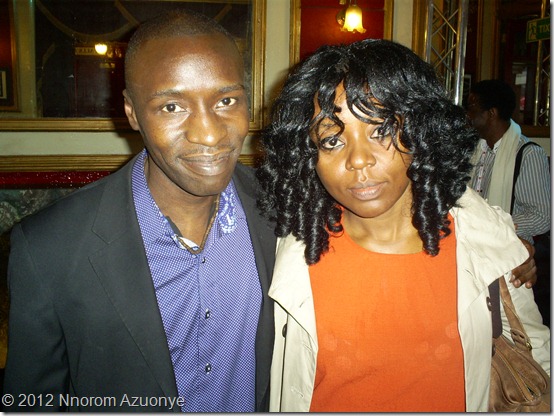
Since the end of July, the Theatre Royal in Stratford has become Nigeria House Stratford and people like King Sunny Ade, Seun Kuti, and Wole Soyinka have danced, stormed off and read poetry on that lovely stage. I was fortunate enough to be invited to take part in two panels about Nigeria Literature. The event was organised by CORA and the British Council and I had a really excellent time. It was great to meet an author like Helon Habila whose work I've read and admired for so long and then to also meet writers who are new to me like Diran Adebayo, the poet and playwright Zainabu Jallo and the poet Nnorom Azuonye of Sentinel Nigeria. All the photos I've put up here were taken by him.

S5033107
Me and Nnorom
Ike Anya (big grin, third from right) was the compere for Monday afternoon. The physical audience was a little scanty but we had some listeners online and questions coming in via facebook. My favourite part of the day was our dinner afterwards. There was an excellent Nigerian 'buffet' going for twelve pounds fifty. Sadly the caterers were mistaken as to the nature of a buffet. We could pile all we wanted to eat on our plates ONCE and only once. In vain did I point out that the term buffet had been inappropriately used and we should be allowed at least two trips. In vain did I bring out my kindle and open The American Standard Dictionary. The food was good though, especially the jollof rice and the conversation was better. Its amazing what fish pepper soup, pounded yam and Star will do. We deconstructed, analysed and solved all the problems with Nigeria. You might say its empty talk but Lenin wandered round Europe for years, talking empty talk. Seretse Khama walked through London for years, talking empty talk. Talk is too easily despised. Nothing begins without words. And anyway, it was fun. I lost my voice trying to keep up with the very loud male opposition and sounded a little croaky in my event the next day.  Rotimi Babatunde (whose fantastic short story Bombay's Republic won the Caine Prize) was the most skilled at the art of conversation, waiting his turn to speak, never raising his voice and always saying what he had to say succinctly. I can only aspire.
caine winners and us
Ayodele Arigbagbu, Lookman Sanusi, Helon Habila, Ike Anya, Rotimi Babatunde, Nnorom Azuonye

There were some organisational issues. African time. AFRICAN TIME. AFRICAN TIME!!! Yes, we know time doesn't control us. Yes, we know we can not be bound by the ticking of the second-hand but at least, let the minute-hand of a clock bear some weight with us. I arrived about forty-five minutes early on the first day, in keeping with the standard practice at most festivals I've been to. That is all I will say on the matter.

S5033096
Diran Adebayo and Zainabu Jallo

To see the rest of Nnorom's photos, click here

Wednesday, 29 February 2012

An Evening with Chika Unigwe

Photo Courtesy Ike Anya
The reading was in a swanky South Kensignton hotel called The Gore. The event was organised by the Dutch Embassy and was billed to start at 7pm. At 7:15 I rushed breathless into the hotel lobby and was  pleased to discover that the Dutch are as flexible with their time as their Nigerian counterparts. There was a nice, dim waiting area and the main event was downstairs.

It was an informal space, with a few sofas against the walls and a wide floor space in the middle. Nigerian that I am, I sharply found a sofa arm to perch on. Sitting on the floor outside your house is just not done. Before the reading began, Chika mingled with her fans. She was gracious, greeting people like me who she's only met once, very warmly. By the time we were ready to start the room had filled up.

She read from a short story called The Love of a Fat Woman. It was about a Nigeriam man who'd married a woman he found unattractively and nauseatingly fat, in order to get immigration papers in the Netherlands. It's a common story that most Africans are familiar with. Interesting, however, was the manner in which this story was told. Chika neither condemned nor condoned the practice but rather wished to humanise it and did so in a very humorous way. The anti-hero prefers his fiance's svelte and attractive friend but she doesn't not notice him. So he settles for the papers that unfortunately come with a corpulent bride attached to them. When he takes her home he promises his mother that he will marry a 'real wife' later on.

 We felt for the main character's over weight and insecure fiancé who believed that their love was genuine. But we also understood why the main character felt that this deception was the only way. We were moved by his close relationship with his family and because of that, it wasn't so easy to write him off as a cruel and unfeeling paper hunter.

The next story she read was  told from the perspective of his relatives at home and their reaction to the Agaracha's new wife. I found this different outlook on events hilarious. His brother's wife, speaking of the Dutch bride's size, described her as a 'room and parlour.' Her earrings which were wooden had to be African because they did not look like they came from anywhere else and there was a lot of wood in Africa. They tried to offer her Western food but she refused insisting on eating pounded yam and even worse, insisting on eating it with her hands. Her in-laws rather uncharitably concluded that she was trying too hard.

sndej.jpg
Chika and her fans. :) Photo courtesy Tokunboh @toksy27
Too soon the reading segment ended and we had reached the QandA. In the second short story she read, she had written in English, Dutch and Igbo and one member of the audience asked how she found the process of moving through those languages in her writing. She spoke of how and why she learnt Dutch. She used to suffer panic attacks because after she moved to Belgium with her husband, she couldn't go anywhere by herself because she didn't understand a word of the language. And when she met her in-laws, she couldn't understand them either. So she had to pick up the language quickly.

She spoke about Belgium and why she had felt compelled to write 'On Black Sisters Street', her novel about Nigerian prostitutes working in the red light district. She described the Catholic home she had grown up as one where sex was rarely talked about. One of her favourite songs in her childhood was 'Let's Talk About Sex' by Salt and Pepper. However, the word sex was such a taboo that she substituted it with 'bread.' So whenever she sang it, the song became,  "Let's talk about bread baby." I can imagine that the next line would be, "Let's talk about yeast and dough."
 Dry.
 I know.

So anyway, coming from this background, to get to Belgium and see sex everywhere was certainly a different experience. She described women in their lingerie, posing in glass windows waiting for their customers and she discovered that many of the girls were Nigerian and in particular from Benin. So at first, she tried to write the story without meeting the girls and on showing it to someone, they advised her to meet the women if she wanted an authentic story. So she put on her mini-skirt and took her husband with her to the red light district to meet them. The stories she heard were harrowing. One girl had been invited to Germany by her estranged father who had then sent her to live with a 'friend' in another European country. This 'friend' had run a brothel and the proceeds of her work had been sent to her father in Germany. She told of women without papers arrested by police and allowed to leave on the condition that they slept with the police men first.

She also, very excitingly, said that her next book was coming out in June. It's set in Nigeria and is about a relationship between a mother and a daughter. And her next-next book is going to be a work historical fiction set in the eighteenth century. I'm very, very excited about that one, being a history student et al. It's just been delivered to her agent so hopefully, we'll see that on the shelves soon as well.

And then just like that the evening was over and it was time to go and face the more mundane things of life like grocery shopping and dissertation writing. Chika closed to applause and flowers, which was exactly what you would expect.   

Wednesday, 26 October 2011

Commonwealth Short Story Prize and A Cool Video

It's that time of the year people. To all writers out there, young and old, brush up your best short story and submit it. You have nothing to lose. It's free to enter. Click here for details.

And just because I saw this video and liked it. The great Jimi Solanke, reminding us why Nigeria is wonderful. In your spare time, check out www.419positive.org

Monday, 24 October 2011

Reading


I know. I know. This gist is so stale that mould is growing on it but better late than never. Abi, no be so? So my university was kind enough to organise a reading for me. It was in the nicest hall in Kings in my opinion. We usually have exams and lectures in the Great Hall, so it was pleasant to see this more sociable mien of this room. Here are photos kindly provided by Kal Kohli who works in the Governance and Legal Affairs Support Office at Kings. A few are mine as well. I'll put the pictures up, then give you a few thoughts.

The audience before the reading began. The back rows got a few late comers as the reading progressed.

Darren Robinson, who was the host for the night. He really gave the reading structure.

If you look closely, you can see me clutching the podium.

Afterwards. Big smiles. These were the main organisers of the event.

My grandma and I. Three generations of my family showed up to support me. Much appreciated.

So basically, giving a reading was a really weird experience. I now know that I am capable of speaking clearly in a Nigerian accent. I do not have to resort to phonetics to be understood by people who are not from my part of the world. However, I must confess it took quite a bit of practice, especially in the areas where I had to speak pidgin. My favourite part of the evening was the Q and A session. I found the actual reading disconcerting. I'm more used to singing in front of people and getting some sort of audible reaction from the crowd. To look up and see upwards of 50 pairs of eyes just watching you silently is very odd. Hence the podium clutching.

I really liked answering people's questions. There were some I'd vaguely been expecting, so I had rough answers for them, e.g how long did it take you to write the book? How do you balance writing with school work? Others though, I hadn't even thought about. One lady asked me to list three books that had influenced me. It's one many writers can reel off but I was momentarily stumped. A Ghanaian woman made a comment about how much she liked Nigerian pidgin and how Ghanaian pidgin was less expressive. One asked about what advice I would give to other young writers like myself.

Afterwards, I mingled with a very kind audience. Many people came to say well done. To be honest I was a little surprised by the diversity of people there. There was a lady from the Czech republic who told me that my reflections of growing up in Nigeria and moving over here, really touched her. Which touched me. In the absence of a book, I even signed a sheet of paper for one lady. It was a great first reading. I was speaking to my editor who attended and we both agreed that it was unusual to have such a nice first outing. We thank God. Obviously, I can't show you guys what I read from my book, copyright etc, but I can put up the introduction I read. Enjoy.

I grew up with a slight sense of distaste for my country. I was fortunate enough to spend some of my holidays in England and America. As a result, I became like one of those badly behaved children who loves to go to other people’s houses but hates to go home. England, in particular, was the cool friend. I remember when the summer was over and it was time to return to Lagos, the back to school adverts would start popping up. And how I wished I was going back to school with the British children. O to buy WHSmith stationery all year round. I got my wish. I came to school in England when I was fourteen. The reality was worse and better than I imagined.

My first few years in England, I felt very homesick for the country I never wanted to return to whenever I holidayed abroad. For the first time, my country, Nigeria, Lagos, was attractive enough and interesting enough for me to want to write about it. Prior to my coming here, I set all my fiction in England and America. Yet I soon found that I did not want to write about England when I finally lived here. The longer I stayed away from Nigeria, the more interesting, and exotic, and readable my country became.

So 4,ooo miles away, sitting in my cold room in school, I began to type away at the nucleus of what would eventually become my novel. For the first time, it would be set in Nigeria, with Nigerian characters, with Nigerian accents. For the first time the hero would be Nigerian, the villain Nigerian, the clown Nigerian, the battered, bruised, humoured, abused, loved, hated, laughed at, all would be Nigerian. It took me four thousand miles to believe that my country was interesting and complex enough to be read about at home and read about on a world stage. It was a while but I am glad I made it in the end.

Monday, 3 October 2011

7 Questions for Ayodele Olofintuade


Ms Olofintuade has just been shortlisted for the Nigerian Prize for Literature for her children's book, ENO'S STORY. Before I go on, I must state that the prize money runs into the hefty sum of $100,000. Children's fiction is often overlooked by the bigger prizes so I'm glad the the NLNG decided to pick a shortlist of only books from this field.

The last time I read a work of children's literature was over five years ago. I thought I had outgrown the genre. I thought wrong. I thoroughly enjoyed Eno's Story. The main character Eno, is a plucky kid who reacts to being accused of child witchcraft with courage and a sense of humour. The first thing Eno says in the novel is, "So I'm a witch! That means I can fly and turn into a cat or even a fierce lion." When her Uncle takes her for 'deliverance' she says to herself, "I am a princess not a witch. Uncle Etim and the pastor are ignoramuses."

The subject of the book is timely. I heard about the child witches scandal in Nigeria but I couldn't bring myself to watch the documentary. It's rare to see children's literature tackle such a tough issue but the most memorable pieces of child fiction often deal with difficult themes. The Boy in the Striped Pyjamas by John Boyne comes to mind. Also, The Book Thief by Markus Zusak.

The illustrations in this book are beautiful. I don't think I've ever seen black people depicted in children's literature, except you count Enid Blyton's golliwogs as black, which I don't. Eno looks like a Nigerian girl. Her hair is threaded. Her evil Uncle looks like a middle aged Nigerian man. He appears in a white singlet and sports a pot belly. The houses in the village look like houses in my village.

Ayodele was kind enough to answer some questions that I posed to her. Here is the full interview. If you live in Nigeria, head over to book stores and get a copy of this book. If you live abroad, get someone to send it to you. I wish Ayodele all the best in her writing. She certainly fully deserves a place on the shortlist and I'm looking forward to reading what she produces next.

1. Before I read the book, I knew that it dealt with the theme of so called child witches and I felt that this was a topic too gruesome to be explored in children's fiction. I was glad that you found a balance between the darker and lighter elements of the story. How did you manage to achieve this?

In order to write successfully for children you need the ability to see through their eyes and I don’t mean that in a derogatory way because I was shocked when someone who purportedly writes for children told an audience that she had to ‘go down to the children’s level’ implying that children are inferior and thus one has to ‘lower’ oneself in order to talk to them, that was a cringe-worthy moment.

All I did was channel the story through a child and completely lose myself in the character, I allowed her to tell the story in her own way, luckily for me it worked!

2. How long does it take you to craft a piece of fiction such as Eno's Story and what are the difficulties you find along the way?

Crafting a story sometimes takes months and sometimes the story will come to you whole. So really one can’t predict how long it will take. For Eno’s Story I had the first draft out in three months, it’s as if the story were hiding behind my back and it just revealed itself to me gradually. I can’t say I encountered a lot of difficulties, at least nothing that couldn’t be solved with a bit of research.

3. The illustrations in Eno's Story were excellent. They really brought the characters and narrative to life. How involved were you in this aspect of the process?

Frankly I had little or no input as the illustrations that were sent to me for approval had undergone thorough scrutiny.

4. What are you currently working on?

The Terrible Twins series, the adventurous stories of a pair of twins, Tounye and Kela, who got into scrapes as a matter of course and their friends: a boy called Khalid and a magical creature called Iwin. The draft for the first four books are ready. Hopefully it will be out by mid 2012.

5. What advice would you give to writers who wish to write for children?

Get to know your audience ... children. Play with them, fight with them, listen to them and don’t ever condescend to them. Once you get that part right you will find it easy to write for them.

6.What was your reaction when you found out that you had been shortlisted for the Nigerian Literature Prize?

Frankly I was happy and sad at the same time. It is very anxiety inducing and I’m already an excitable person so I knew I was going on an emotional roller coaster ride. But thus far I’ve handled it even better that I thought I would. I have really surprised myself.

7. I know this last is a little cheeky and I'll understand if you choose not to answer but if you did win, what would you do with the prize money?

SPEND IT!


Wednesday, 21 September 2011

An Evening With Ms Adichie, Mr. Ellams and Many More @ BookSlam

I got there on time. 6.30pm. I didn't have a ticket and I was worried that I might be gated. I didn't know the size of the venue. It would have been a shame to go all the way to Clapham only to return to North London. The queue was long when I got there. Too long for an event that started at 7.30. I saw some of my friends. We had randomly come to the same event. They all had tickets. I wanted to run to the front and tell the guys to save one for me o. I came from North London. You will pay my transport here.

In the end there were tickets for everyone. The venue was quite large. When we were all inside it was full but more people could have fitted inside. If it was an event in Nigeria, I would have shown the organisers how to arrange the chairs to increase capacity. As it was, the Okoro Lagosian in me tried to calculate how much Bookslam made.

First poem of the night went to the host, a poet whose name I do not recall, though some of his lyrics have stuck in my head. The poem was called Invisible Kisses. I won't try and reproduce his wraps here but they were good sha.


Next up was a poet called Inua Ellams. I've seen him perform before. He came to my Uni for a performance. I went because the poster said he'd done a show at the National and I'm into brand names like that. He was good at Kings but better yesterday. Lighting really makes a difference. When the crowd is dark, I think performers have more liver. He had an excellent poem about about domestic violence. There was a particularly graphic image. A drop of blood fell into the victim's cup of coffee. There's a tinge of bathos when I paraphrase it but it was very powerful in his words.


And then we had Ms. Adichie. She's loomed large in my mind since I was a child. I was 0 years of age when Ben Okri won the Booker with the Famished Road. Between that and Purple Hibiscus there were no Nigerian writers people all over the world were making noise about, except the usual suspects: Achebe, Soyinka, Achebe, Soyinka. So of course when Chimamanda stepped on the scene, how could you say you were a Nigerian and an aspiring writer and not know of her. And have an opinion on which novel was better, Purple Hibiscus or Half of a Yellow Sun. And have family members ask, ''So you want to be the next Chimamanda?" when you said you wanted to be a writer.

The short story she read was excellent. It was called Quality Street. I was able to follow every word she said. Don't underestimate the skill required to speak in a Nigerian accent and still convey your words with clarity to an audience that is not solely African. I have my first reading next month.

I went to speak to her afterwards. She was cool. It's an oft used adjective but its the most apt I can think of. She chatted to people normally, like a naija. You know how my people like to hear our people keeping it real. There was no authorial distance. She signed everyone's book, heard a hundred people say how much they loved her books and took each compliment graciously. She was cool. I'm glad I went.

Friday, 12 August 2011

Teju Cole and Nostalgia

I heart this guy. His next work is non fiction, set in Eko, describing my city. He reads from it in this clip. It is such a powerful and evocative extract I want to get on a plane and return to my country. He has made me so homesick.

Me I like my country,
My country very good o,
Everything dey for my country,
So let us join hands and make Nigeria greater.

It was a song we used to sing when I was younger. Do you remember this one?

O eba, O eba,
When shall I see dodo
Ireti give us food o,
When I think of Egusi and Iyan,
I will never forget pomo.

And this one

There are seven rivers in Africa,
Nile, Niger, Senegal, Congo, Orange, Limpopo, Zambezi,
Azikiwe, Mohammed, Tafawa Balewa
White man don take the crown from us.

Anyways, here is the reading that sparked off all this nostalgia.

Friday, 29 July 2011

Petina Shoutout


Petina Gappah, (disclaimer: she's also a Faber author) has given me an incredibly nice shout out on her blog. I blush as I give you this link.

P.S
Check out her braids. Next time I go to Nigeria I'm going to do this hair. Unfortunately, it's impossible to do such in England unless you are a millionaire.

Sunday, 10 July 2011

Caine Prize Shortlist, Southbank Reading

Just back from a reading with all the shortlisted authors for the Caine Prize. I was 15 minutes late so I only heard 3.5 stories but all 3.5 were excellent. The winner will be announced tomorrow. I have a favourite but I wouldn't place a bet on it because the standard is so high. You can read the entire short list here.


Lauri Kubuitsile author of 'In the Spirit of McPhineas Lata. Her story was very humorous. It left the audience laughing at loud. Read her blog here.

NoViolet Bulawayo. Author of Hitting Budapest. Particularly loved the fro. Also the name is very unusual. She described herself as a 'literary activist' but unfortunately there was not enough time for her to expand.

Beatrice Lamwaka author of Butterfly Dreams. She had an interesting explanation for why she used the butterfly as a metaphor in her short story. It's because butterflies are difficult to catch, like dreams.

David Medalie, Author of The Mistress' Dog. I really enjoyed his story. It was simple, yet imagined in such detail.

Unfortunately I didn't get a photo of the last author on the shortlist, Tim Keegan. He's a Historian, which is right up my street. Ah well.

Of course the perennial question of whether the writer's considered themselves 'African Writers' came up. Eye roll. Been there. Done that. I liked Tim Keegan's answer. He's a white South African and he likes being called an African Writer because being African is part of his identity, even though his skin is white. Short, sweet and simple. Ok folks. Back to the deadlines.

Sunday, 12 June 2011

Literature is Not Dead


The prevalent view is that literature is only for the rich in Nigeria. Poor people don't read. If they do, its by accident and its nothing intellectual. Thus when my Aunt, Mrs. Mobolaji Adenubi, invited me to a meeting of the Association of Nigerian Authors (A.N.A), I had a very clear picture of what the meeting would be like. It would be on the island, because as we all know, nothing posh happens on the mainland. There would be a few expatriates.The people at the venue might be simply dressed but there would be many fancy cars in the parking lot. Now I must confess that I've never been to a literary event in Nigeria before but from looking at pictures and reading the news coverage, the vibe I've gotten has been that these events have swung more towards the aje botas.


So I was pleasantly surprised to find that most of the people who attended yesterday's meeting did not belong to the privileged class. Even though it rained terrifically, many of the people present took public transport to make that meeting. You cannot understand the full import of this until you have been caught in Lagos rain. The only umbrella I had was my England one: a sturdy thing that has served me well over there but was no match for the Eko rainy season. I came in a car to the meeting and only had to walk about ten metres to the venue. Yet by the time I reached the entrance, the rain had made a mockery of my umbrella and beaten me well well. Now, imagine coming to such a venue in a danfo or even worse on an okada. Even after sitting under a roof for four hours, there was one lady who still left the venue with damp clothes.

The meeting started about an hour late but that was due to the rain. The roads flood in Nigeria during the rainy season and thus traffic increases exponentially. Again, it wasn't a full house because of the rains but those that came, came with their works, ready to read them. Even I, first timer, was offered a chance at reading to the gathering. There were about five poetry readings and one prose piece. After each, the members would critique and advise. The two poems that caused the most debate were about Africa. One member protested about the blanket use of the 'black' to describe Africans. Another countered that majority of the people in Africa were black and even those in North Africa had dark skin. One member found one poem too optimistic about the state of Africa. In his view, the writer was 'deceiving herself.'


Perhaps it was because he was a man or perhaps because the woman who wrote the poem was a shy, the other women in the group took up her cause and after some close text analysis, dragged the rest of the group to the conclusion that the poem was neither overly optimistic or pessimistic but a good balance. There was one man who read so passionately that he could not remain on his seat. He read his poem twice and each time, he started sitting and by the end he was standing, pacing and declaiming his work.

Even I got my own few minutes. Though I had nothing of my own to read, when my Aunt told Dagga Tolar the Chairman of the Lagos branch that I had a book coming out next year (D.V), he put me next to the guest speaker who had come all the way from Ibadan and did a sort of joint interview with both of us. At the end, a small library of books was brought out for members to peruse. Some of the books were from members who had self published and left a copy of the book with the organisation but quite a few were international works. I spotted a copy of Isabel Allende's House of Spirits. All in all, I enjoyed my first meeting of A.N.A. It has shown me that high culture is for everyone.

Wednesday, 6 April 2011

Lagos


Nostalgic description of Lagos by Nobel Laureate Wole Soyinka. Read here. It seems he's been growing the afro for a while.

Thursday, 17 March 2011

Girl Power


This should be interesting. Chimamanda to moderate presidential debate. Let's hope she fires them well well. Read more here.

Tuesday, 22 February 2011

Nothing to Blog About Except...


We interrupt these Publishing Month proceedings with a word from the blog owner.

I am hereby tired of Publishing Month. I've blogged about getting an agent. I've blogged about the editing process and I think these two topics are the only things I really know anything about. If you have an agent, the nuts and bolts of getting a publisher are quite mysterious to you. All I know is that one day my agent told me my book was on submission (i.e she had sent it to editors at many publishing houses) and the next, a publisher was interested. Till today, I still don't know how many editors she sent my manuscript to; I don't know how many rejections I got; I don't even know what synopsis she put of the book.

However, I do know that during the submission process she asked for a nice photograph of me, which I found very amusing. Why would you need to see a photograph to know if you liked my writing? It seems that the magazine culture has invaded even the world of books. I asked my editor recently if she were the one that asked for the photo and she denied vehemently, which means someone out there saw my face and declined THE SPIDER KING'S DAUGHTER. And I thought I was a fine girl.

It was a good thing that my agent kept me in the dark for most of the process I think. When my current editor at Faber asked for a meeting, my agent didn't even want to tell me where we were going. Our conversation a few days to the meeting went something like this.

'So where is the place?'
"I don't want you to get your hopes up.''
''R we are going there on Monday. It's Friday, I need to know where the place is.'
'Faber.'
'Ooooh.'
'I know but don't get excited.'

It was very sensible of her to control my excitement levels. A meeting with a publisher doesn't necessarily mean that they are going to offer you a deal. It's the same way a date with a girl doesn't mean she's going to marry you. If you set your expectations to high, a disappointment can crush you.

R also didn't tell me about the editors who rejected my work. Once, after we'd signed the contract with Faber she mentioned one of these editors but when I pressed she wouldn't tell me more, not even what house they worked for. And this was also good. It's very hard to take rejection for a manuscript you've put so much work an effort to. I've read some writer blogs that say that their agents tell them every single house they submit to, every rejection they get and worst, the feedback from all these rejections. I'm glad I didn't have to go through that. God is good.

My meeting with my editor was shockingly normal. Faber is quite a cosy publishing house and I like that. Their building was empty when I went because it was December and most people had already gone for their Christmas holidays (work in publishing. They get the longest vacations). Me, my editor and my agent sat around a desk and we gisted for about an hour. We barely talked about the book. We just gisted about my childhood, about my editor's childhood, about my agent's childhood, about the publishing industry, about who had a nice cover and who didn't, who'd one the prizes that year, who didn't, who should have. Then about twenty minutes to the end, we talked about the book and the changes my editor would suggest and we were, excuse the pun, on the same page. So I was happy when Faber made an offer but thanks to my agent, if they hadn't made an offer, I would not have been shattered.

So it turns out that I did have something to blog about after all.

P.S
Kudos to Teju Cole who is making tsunamis in the literary world with his debut novel, OPEN CITY. Read his New Yorker review here.

Monday, 21 February 2011

Binyavanga Wainaina


Some stirring prose from the Caine Prize Winner. Read here. And read his article on how to write about Africa here for some tips.

Monday, 7 February 2011

Helon Habila


I discovered Helon Habila when I read Measuring Time, but it was his first novel, Waiting for an Angel, that really resonated with me. I would recommend both books. The first because it expanded my anaemic knowledge of Northern Nigeria and the second because I was alive in the Nigeria he describes yet I never knew how bad military rule was. Anyway, here are some tips from the Caine Prize winner himself. Read here.

Wednesday, 26 January 2011

Top Ten Immigrant Tales


No I did not know that the great Zik of Africa was a potato peeler while he was in America. Read here.

Tuesday, 25 January 2011

E.C Osondu


For those in London, come and see E.C Osondu, the 2009 Caine Prize winner, read from VOICES OF AMERICA his debut collection of short stories. here.
Related Posts Plugin for WordPress, Blogger...