New election single from my sister, Dinachi Onuzo and I.
Showing posts with label Politics. Show all posts
Showing posts with label Politics. Show all posts
Thursday, 22 January 2015

Wednesday, 11 July 2012
An Afternoon With Chief Servant, Governor Aliyu of Niger State

The talk was organised by Chatham House and was titled, 'Nigeria’s Unity and Regional Socio-Political Groups: Influence and Impact of the Northern States Governors Forum' and the speaker was Dr. Mu'azu Babaginda Aliyu, Governor of Niger State and head of the Northern States Governors Forum (N.S.G.F). I saw someone going for the same event on the tube. He was wearing a pin striped black suit, a black shirt and he was carrying a slightly battered, black leather brief case. I don't know how I knew we were going to the same place. I just did. My Naija radar went on alert.
I arrived at the venue just as the governor was making his way to the podium.The room was almost full and there were only a few empty seats. A woman manning a camera on a tripod stood in the middle of one aisle. She was wearing a flowing gold kaftan with rich embroidery on the edges and a shawl was wound round her head. The NTA logo, unmistakable brown and orange, was printed on the side of her camera.
By the time I had settled down in my seat, the governor had started speaking. He was heavy set with bags under his eyes but he seemed like a jolly person. He had a curious habit of flicking his tongue out when he was about to crack a joke, which happened often during his talk. He began by recognising the members of his entourage.
Chairman of the Traditional Council.
Emir of Minna.
Speaker of Niger State House of Assembly.
An Honourable from Niger State.
These are not all the people he mentioned but these were the posts I got down. He then moved on to give a brief biography of the N.S.G.F and the role it has played in Nigeria's recent history. It was made up of the 19 states in the North West, North Central and North Eastern part of Nigeria. According to Governor Aliyu, the N.S.G.F had played a pivotal role during the Yaradua crises as it was the first group to call for Goodluck Jonathan to be recognised as acting president. Lastly, a point which he reiterated throughout his talk, the N.S.G.F did not believe in the break up of Nigeria.
He gave a lot of interesting statistics. 10% of Nigeria's land mass is in Niger State. 80% of the land in the state is used for agricultural production and although this farming is carried out on a subsistence level, it is still enough to provide the country with 1/3 of its rice quota.
I must say that there was little in the main body of Governor Aliyu's talk that I disagreed with. He spoke of the unconstitutional nature of a Sovereign National Conference saying, 'You can't have two sovereigns in one state.' There was already a body of elected individuals drawn from all over the country whose job was to handle matters such as the redrafting of the constitution. It was called the National Assembly and in any attempts to change the constitution, they must be at the fore.
He also spoke about the spurious division between the so-called 'settlers' and so-called 'indigenes' in Niger State, drawing parallels between his state and the situation in Jos at the start of their crisis. A good number of Niger's 'indigenes' were actually Hausa speakers from neighbouring Chad and Niger and they were appropriating benefits meant for Nigerians at the expense of 'settler' Yorubas and Igbos who had lived in the state for decades. For example, 'indigenes' paid lower school fees than 'settlers' and so he abolished the payment of school fees in the state.
He spoke of religious radicalisation in Niger, giving as an example the group Dar es Islam, a name which roughly translates to The House of Islam. It was a group that began in the 1970s with 7 people and by 2007, had grown to 9,000. They believed that anyone outside their group was not a Muslim. When members of the security forces were sent to spy on the group, they ended up being absorbed into it. Eventually, more concerted government action was taken and it was discovered that 3/4 of Dar es Islam was not Nigerian.
He then moved on to talk about what he termed the 'Boko Haram franchise,' starting this segment of his talk with a joke saying, 'The Boko Haram thing. I'm sure many people will be interested in that thing.' The franchise nature of the group was of course that anyone wreaking havoc, including armed robbers could do so under the masque of Boko Haram.
Sometimes he would segue into random asides that were neither here nor there. When he briefly mentioned the crisis in Jos, he also spoke of the Fulani channel than ran throughout West Africa. According to him, whenever a group of Fulanis was threatened in one part of the continent, they would send kolanuts to their brethren elsewhere and these would then come to their rescue and avenge any wrongs perpetrated against them. Such urban legends are the stuff ethnic distrust is made of.
He closed his talk with the now familiar mantra of all state Governors in Nigeria, from the East, South, North and West. He called for decentralisation and more devolution of power to the states.
 |
| Niger State on Map of Nigeria |
During the QandA, a question was asked that allowed the Governor to tell us about the administrative structure of his state. There are 29 local government areas and 274 wards. He discovered that very few policies made at the state level were trickling down to the ward level and so he made a novel amendment. Every month, 1 million Naira would be given to each ward to carry out whatever project they wanted. The only condition for receiving another million the next month, was proof that a project was being carried out. Explaining the rational behind this policy he said, 'the villagers know their problems and have solutions to their problems.'
Yours truly worked up the courage to ask a question. I was so scared, I forgot to introduce myself and was reminded of this by the vocal crowd. It's a question I want to ask to every Nigerian official who expresses support for the removal of the fuel subsidy as Governor Aliyu did in his talk. Here it is;
'You mentioned that you supported subsidy removal which was in effect an austerity measure. What personal austerity measures have you taken since January. For example today, I see you've come with quite a large entourage.'
Yes, I said it. He took it quite well actually. He smiled when I asked the question and when he answered, he addressed me directly. He explained that when he travelled, he liked to bring members of his state for short educational courses and he also wanted to expose them to what 'Chibundu was thinking about them abroad' and how the rest of the world saw them. I found myself warming to the Governor of Niger State. He seemed a good sport.
Not so his supporters who accosted me on the steps when I was leaving.
"Are you the one who asked the Governor that question about his entourage?"
"Yes," I said to man in the black suit, not the same one I had seen on the tube.
"Well you should get your facts straight then. Not all the people that came live in Nigeria."
"So you're telling me the Speaker of the Niger State Assembly does not live in Nigeria?"
"Not him but-- just get your facts straight," he barked.
There were about five of them who I then entered into a discussion with about the rights and wrongs of travelling with a large entourage while pushing austerity measures. Only one was conciliatory and polite. He, I think, was the only actual member of the governor's entourage. The rest seemed to me to be Nigerians in London looking for contracts.
"So where are you from?" one of the ruder members of our discussion asked.
"I'm from Lagos."
"Come on. With a name like that you can't be from Lagos."
"So you're now making distinctions between settlers and indigenes."
That drew a laugh from the group. Better quit while you're ahead, I thought to myself.
"It was nice to meet all of you," I said quickly and walked up the stairs before somebody will just dash me hot slap.
My name is Chibundu Onuzo. God bless and good night.
Friday, 23 March 2012
Tabia Princewill Speaks

Musings of a frustrated Corper
To face up to the glaring deficiencies of the dinosaur we call NYSC, government needs to implement more than surface reforms. For many today, NYSC is an ordeal; a necessary evil; a rite of passage whereby one learns to adapt to the flawed codes of conduct in our society. Indeed, NYSC is a foray into the real world which ideally should teach best practices and attitudes conducive to our development and progress as a country. Ironically, the scheme in its current configuration does quite the opposite.
Corpers are regarded as cheap labour by the organisations who employ them and one very often spends the service year running errands, some highly degrading others simply pointless and non relevant to the job at hand. There is no obligation for the corporate world or even the public sector for that matter, to train the corpers they take on. Rather, youth service becomes a sort of demeaning servitude. Let us speak plainly about the real issues at stake and go beyond surface reforms: female corps members are harassed not because they have no martial arts training (contrary to what proposed reforms would have us believe) but because there is little to protect them from sometimes predatory and unwanted attention. Their inability to mimic Karate masters is irrelevant. It is the very philosophy of NYSC, the unequal relationships between corpers and their would be co-workers that is the problem.
Different sets of rules apply for individuals depending on their class, social status or occupation. Corpers, hard working graduates called to serve their country, are perceived as being at the very bottom of the social pyramid rather than the nation’s pride. So they are ridiculed and taken advantage of. Despite the present reforms there is still nothing to protect corps members as concurrently there is no social security net to protect the poor, the elderly and the weak in our society. NYSC currently is an exercise in adaptation to the functioning of a dysfunctional society: a way of learning in practical terms about inequality and injustice.
So what is the point of NYSC? Beyond the objective of national integration, what is a corper meant to gain at the end of his or her service year beyond an often thoroughly degrading and sometimes even traumatizing experience where girls face the lewd advances of men in a position of power and young men are frustrated and angered by the fact that after being used in all sorts of ways, most companies will not retain them? Our government asks Nigerians to love their country, serve it with all their heart and mind, respect their leaders and the laws of the land but gives nothing or little in return. No modern society is based on such unequal dealings. The National Youth Service Corps must provide young people with a career path, a set of skills from which they can earn a living. This should be the core requirement of the scheme, a key term of the contract between the Federal Government and all organisations in both the private and public domain.
NYSC can not be a success, will not add value to both corpers and organisations if there is no training process or clearly defined tasks for corpers to undertake during their service year. As for being retained, so few companies do. This should not be so. Abroad, many organisations hire interns for the year and review their performance at the end of said year. It is impossible to offer a job to everyone, but it is unheard of to offer a job to virtually no one besides the children of those who have family or friends in the organization. As for corpers in the public sector, for them too there should be the possibility of a career path beyond NYSC.
The current reformist idea is to post corpers mostly to rural areas in dire need of the manpower to develop these communities. The problem here is that corpers are regarded as ‘manpower’ and not as individuals with dreams and aspirations and who deserve, just like anyone else, to have a fighting chance at achieving their potential. Should corpers pay for the inefficiencies of governments who were not able to develop rural areas? Serious reform is not to decide that corpers should solely be posted to rural areas where they can serve their country as teachers and doctors when they might have no desire, interest or more importantly ability to do so, thus creating another generation of dissatisfied Nigerians who take out their frustrations on the future youths they encounter!
The path to real reform is to ensure that corpers in different sectors are properly trained for a job and acquire skills and prospects. A nation which fails the youth by its inability to provide them with a decent future is surely failing in its developmental objectives. I would also like to remind government that “without debate, without criticism, no administration and no country can succeed and no republic can survive” (John F. Kennedy) so rather than believe criticism to be the work of enemies, real, spiritual and imagined I would like to urge government to act. As the grunt of Nigerians continues to suffer government’s inaction in silence, as some members of society respond to their frustrations through violence, one can only hope that we are all able to rise to the responsibility and challenge of creating a better Nigeria.
Tabia Princewill
Tabia Princewill is currently a corper in Lagos.
Wednesday, 1 February 2012
Graduate with a CV

The Minister for Youth Development in Nigeria, Mr. Bolaji Abdullahi has come again. It seems for the Nigerian corper, one week one trouble is the recurring theme. The government has not effectively addressed how corpers can go to the toilet without having to squat over a hole in the ground. Yet, our Minister for Youth Development has come up with a new plan to completely re-design the NYSC scheme. If he is successful, from next year NYSC will 'post corpers to rural areas only with no provision for redeployment.' Mind you, Mr Abdullahi of course is very sympathetic to the plight of the youths. In his own words, 'Corpers would no longer be posted to banks and other organizations where they are always being rejected.' They will now be posted to villages where their main concern will be 'agriculture, rural health, infra structure and education.' Mr Abdullahi's idea it seems is to turn our graduates into farmers using primitive instruments because I for one, have never seen a tractor in my village.
This talk of reform got me thinking of a conversation I had with my cousin last year about the NYSC. He currently lives and works in America and I asked him when he was going back to serve. Never, he said. He felt the system was useless as it failed to provide students with meaningful work experience. He then continued to detail the direction he wished to see NYSC reforms going in. With a little editing (cutting out the bad bb speak), I'm just going to cut and paste that conversation here. Let me know what you think.
E: NYSC should be incorporated into the university system. That is where it will be beneficial.
Me: Ehen go on. Explain.
E: It is a form of internship (since the job is not guaranteed)
Me: So when should you do it. Over summer or something?
E: It would be beneficial to incorporate it to a student's major so they can get a taste of what they would be doing when they graduate. Over summer for their third and final year.
Me: So twice. Some universities here do a year out type of thing.
E: We have it here, it is not mandatory but people get it in their third year and intern the whole semester. It also counts as college credit. And you get paid as well.
Me: By who, the job or the university?
E: The job.
Me: But university is already so long in Naija what with strikes etc. Some people just want to graduate sam.
E: The job pays them, the student pays the school and gets credit towards the degree.
Me: Ah I see. If it was added to your degree, you wouldn't have to spend an extra year. Then the options could be: do NYSC for a year as credit for university or graduate and do it, thus spending five years.
E: Well it could be mandated.
Me: That's not fair. In America etc its by choice isn't it. Too much by force tings for Naija.
E: It is, but we don't have NYSC. So if you have to mandate something, mandate it when folks can actually apply what they are learning.
Me: It's not a bad idea. And that way people can actually get relevant work experience because sometimes, you are posted to things you don't have a background in.
E: Exactly. You graduate with a 'CV'
Me: That can be the tagline. 'Graduate with a CV.' But wait! What about the foreign graduates. They must suffer too.
E: Why does it have to be considered suffering? The camps are a waste of time. It is another avenue for politicians to chop. It is not needed.
Me: This is true. But that community development part should be there. It's important. How will foreign students get that?
E: How many people utilise the community development?
Me: You'd be surprised. People in rural areas don't have much choice really. It's the people posted to Lagos etc that skive.
E: The money that would be spent on the upkeep of NYSC should be allocated to specific individuals to perform these tasks.
Me: I don't get.
E: It will create more jobs sef. What does community development entail?
Me: One day a week you do CD and the remaining days are for your job/work experience. So for example, M[another cousin] was posted to work in a school and she was an SS2 English teacher in a state school for a year. Also, another thing about NYSC is its supposed to create national unity.
E: Chibundu you have more sense than this nah. What is supposed to happen and what actually happen are totally different. The sad part is that the actual vision of NYSC has been lost and now we hear all the ills that are going on in these camps.
Me: No but people still get posted all over Nigeria. A new scheme has to incorporate the ideals of the old. Maybe your work experience must be found in a state you don't live in and you can then do community development one day a week during your stay in that state.
That's how far we got before the conversation petered out and moved on to more trivial things. But what do you think about my cousin's 'Graduate with a CV' idea? I think it's excellent. There are still some holes. How does one incorporate foreign graduates into such a system for example? But for the bulk of students who take part in this scheme and are Nigerian graduates, I think such a plan would be a massive improvement. What say ye?
Tuesday, 24 January 2012
An Evening With Lamido Sanusi

His talk was titled 'The Global Banking Crisis: an African Banker's Response' and even though at times he retreated into an obscure financial lexis of mutual funds, recapitalisation and long term financing, I could generally follow the gist of what he was saying.
In 2007-2008 when the first round of the global crisis hit, Nigeria was spared the impact because in many ways, our financial market is isolated from the big deals. In the second wave of 2009, Nigeria took a hit. Oil prices crashed from $147 a barrel in 2007 to $47 a barrel in 2009 and our crude oil based economy took a plunge. According to Sanusi, in 2007 the Nigerian stock exchange was one of the best performing in the world. By 2009 we were one of the worst performing. It was in this same year that Sanusi became Central Bank Governor. He was too modest to say that since his advent the banking industry in Nigeria has changed for the better but this can be inferred from what he told us next.
With banks about to collapse, the Central Bank stepped in. The industry was a mess. Banks were lending people's savings to speculators and petroleum marketers who rarely repaid their loans. Some banks owned 25% of themselves and traded in their own stock. Sanusi spoke of the 'biggest fool theory' where someone who bought a share for $10, sold it off to a bigger fool for $12 who sold it off to an even bigger fool for $15 who after some wrangling sold it to the biggest fool for $20. At which point the biggest fool realised nobody would buy it from him for higher than $20 and the value of his stock plummeted.
Sanusi spoke of a culture of failing banks in Nigeria where C.E.Os would run their banks aground with poor management, the government would take over and these C.E.Os would go and build houses abroad, come back to Nigeria and become senators and governors. In Sanusi's words, "Banks don't fail. They are cured. We were going to save the banks and find the people who killed the banks." On further inspection, after the Central government had taken over some of these banks on the verge of extinction, it was discovered that it wasn't just poor management that had killed these banks but blatant fraud. Lenders and borrowers were the same people. Money had been taken out of the bank to buy real estate abroad. In one case, 200 pieces of Dubai real estate were found to be owned by a C.E.O.
What followed was a process of carrot and bulala from the C.B.N. Every bank CEO who had been in office for ten years was forced to leave. Most had become entrenched, too powerful for their boards or workers to resist their schemes, whether legitimate or illegitimate. Non-executive directors who had been sitting on a board for over twelve years had to leave. And on the part of the executive, no C.B.N governor could take an appointment in the private financial sector for 5 years after leaving office to get rid of allegations that the C.B.N governor had made policies that would benefit him in his retirement from office. As a result of these new measures and investigation, Sanusi stated that 'we have so far jailed one bank C.E.O and are looking to jail two more.'
On the carrot side, Sanusi organised a weekend away with the C.E.Os of all the banks in Nigeria to find out what went wrong. It was the first meeting of its kind where the C.B.N and the private banking sector had a chance to talk in an informal setting. As Sanusi surmised, there was a 'complete disconnect between the balance sheets of banks and the real economy.' In a country where 42% of the work force was connected to agriculture, why was only 3% of bank lending devoted to this sector? To put it simply the banks were afraid. To lend large amounts to any sectors outside telecommunications and oil and gas seemed too huge a risk in a country like Nigeria.
A country that grew tomatoes locally but was the world's biggest importer of tomato puree; a country whose highest UK import was refined petroleum, a country that exported imported petrol to other West African countries, a country that imported 5 year old rice from grain reserves, Sanusi even quipped, a country where "General Abacha conducted free and fair elections in Liberia when we didn't have elections in Nigeria. We actually exported democracy." In such a topsy turvy place, you can see why banks were afraid to invest in anything other than the proven cash cows: petroleum and telecommunications.
Of course, the subsidy issue came up. Early on in the evening he joked, 'If there are any Nigerians with shoes, please warn before you throw them.' He added before the QandA session began, 'I've read all the facebook comments. I know half of the people in this room are not happy with me over subsidy.' And in true form, once given the opportunity, many in the audience zeroed in on this issue of subsidy removal.
 |
| Sanusi taking questions |
Just as an aside, our people can be very funny. Some stood up and listed all their qualifications before they finally got to their question. Really, do we all have to know what your Common Entrance score was before you ask your question? Others didn't ask questions but made impassioned speeches about the unfairness of subsidy removal. One audience member asked in what I assume was a rhetorical question, "If the UK government catches people claiming welfare benefits they are not entitled to, will they decide to scrap welfare altogether?" I'll leave you to draw the link between his question and the removal of the petrol subsidy.
We've all heard the economic pros and cons of subsidy removal. For perhaps the millionth time in the last 23 days, Lamido said, 'I don't have any ideological opposition to subsidy but subsidise production." He added that the subsidy was a hedge because there was no arrangement for rising oil prices so sometimes the government in paying a subsidy, paid more than the consumers 65N. He explained that subsidy payments were made on the basis of documents. 'If you bring me documents saying you brought in 10 million litres of fuel, I will pay you 7.5 billion. If you're a Nigerian, you will bring me those documents." On the matter of policing smuggling of subsidised petrol to West Africa, he pointed out that 22 out of 36 states in Nigeria shared land borders with other countries. He painted a grim picture of the furlongs of barbed wire that would be needed to secure such borders. Even in his adamant defense of subsidy removal, he was at least gracious enough to admit that government had failed in communicating the policy to the people.
What I enjoyed more than this subsidy rhetoric, was Sanusi's poking fun at Nigerians. He spoke of how at a meeting of bankers he had said, "The Nigerian stock exchange has a total capitalisation of $40 billion." Those assembled had applauded. Next he said to them, "This makes ours the third largest stock exchange in Africa." Again, more applause. He concluded, "Yet that is only equivalent of half of the total value of Goldman Sachs...after the financial crisis." The room went silent.
And of course there is the characteristic irreverence he shows to those in power, making you forget for a moment that he is one of them. He joked that the people who complained most about the C.B.N cashless economy initiative, were those who needed to carry Ghana must go bags of cash around in the night. He added that whenever he goes abroad and people ask, 'how come oil prices are going up and foreign reserves in Nigeria are going down?" he would very much like to answer, "Because people are stealing the money."
I found myself warming to Sanusi. It was unfortunate that nobody asked what austerity measures government members were applying to their pay cheques now that they were making the country swallow the bitter pill of subsidy removal. It would have been even better to find out what measures Sanusi himself was taking to make sure his expenses sheet tallied with this mood of austerity. Perhaps such a question would have made him squirm and his effortless delivery may have stuttered. But I doubt it. The man is a cool fish.
He ended his talk by saying that 2012 is the year of the woman. The C.B.N will allow loans taken by women at single digit rates of interest. It is well known that women are the driven force in small and medium scale enterprises. I will clink my glass to such a policy any day.
Thursday, 19 January 2012
The First Time I Was Corrupt

We got to the venue: a large but shabby state school. The hoops were sparse metal rims. No netting hung down from them, like in the NBA. Our first match was scheduled. We went to our court. Our P.E teacher, Mrs O, read out five names. None were mine. She must have seen the fallen faces of the rejected five because she said to us,
"Don't worry. There are many matches today."
The match began. The rival team scored early. Mrs O began to grow agitated on the sidelines.
"Amaka shoot!"
"Deola pass the ball!"
"Shoot! Shoot!"
We were losing, time was passing. Mrs. O called a halftime.
"Deola come and sit down. Chibundu go on."
Me. I was going to play. Me!
The referee brought the sheet that had to be filled whenever a player stepped on the court. Standard questions, Name, School, Age.
Name. Mrs O wrote Chibundu Onuzo.
School. Mrs O wrote Atlantic Hall, Poka-Epe.
Age.
"How old are you?" Mrs O asked, her pen poised above the page, impatient to write. Time was going.
"Thirteen."
"Ah this tournament is for twelve and under."
"But I'm thirteen."
"It doesn't matter. I'll just put twelve."
"Wait," I said, my heart beginning to pound.
It's not that I hadn't lied before. Lies a plenty filled my past. Who drank my Fanta? Who wore my skirt? Who moved my cheese? All questions, I had lied to. But to lie on an official document. To lie about something as fundamental as my age. To tell such a lie, though sanctioned by my teachers, went against everything my parents had ever taught me.
"If I don't put twelve, you can't play."
And I'm afraid to say that sealed the deal for me. Not play, after waking up so many mornings. Not play, after driving two hours to reach this venue. Not play and let one of the other subs take my place. Tofia.
So with my heart pounding, I walked onto the field. Needless to say, I was rubbish. I missed the ball when it was thrown to me. When I caught it, I lost it immediately. I couldn't concentrate. My lie hung too heavily on me. I could hear Mrs. O screaming on the sidelines but it did nothing to spur me on. When a pass I intended for a team mate, ended up in the hands of an opponent who scored a few seconds later, Mrs O shouted, "Time out. Chibundu come and sit down. Deola, you're going back on."
I walked back to the side benches. The other subs made room for me as they offered their condolences.
"You did ok."
"You'll do better in the next match."
"Don't worry."
But I wasn't sad. I was relieved. For the rest of the day, I watched my mostly thirteen and fourteen year old team mates cruise to the silver medal position. When the medals came, even the subs got them. I wore mine proudly around school but secretly, inside, I was glad I had nothing to do with the winning of it.
It was my first taste of corruption and it left a funny feeling in my mouth, like the taste of fruity lip balm, sweet but toxic nonetheless. Hitherto, I had never been directly complicit in anything corrupt. True, bribes had been given on my behalf. I had sat in the car and watched the driver pass money to the low ranking officials whenever we were flagged down for no reason at a police checkpoint.
"Give us something," the bluntest of the police men would say as we pulled over. I was relieved when the drivers paid. I was afraid of the guns but every time money changed hands, I was also angry.
"When I'm older," I would say to the driver after we had driven off, "When I'm older and I have my own car, I won't give those people money."
"If you don't give them," the most pragmatic of the drivers once explained to me, "they will make your life hell for nothing. Better to just give them the twenty Naira and go your way."
I would be different, I thought. I would be the one who would stand by the roadside and refuse to compromise my integrity for the sake of my convenience. Yet, how easily my moral defenses had crumbled when I had to choose between them and something I wanted.
I imagine it is the same for many of our bloated politicians. It is true, some have always been thieves but enough were scrupulous enough in their private careers, for one to wonder how such volte faces took place. We have watched honest enough doctors become thieves. We have watched cabinet members who were highly ranked in the private sector and relatively honest there, become treasury robbers over night. We have watched speakers of the house come from abroad, where they never had criminal records, and begin to dream up the most inventive acts of fraud.
I had never had the opportunity to lie about my age and I had never had the motivation to do so. I imagine it is the same for many of our politicians. Opportunities to steal abound. Motivations to steal can always be found. School fees are due, new house is needed in the village, wife wants diamond earrings for anniversary and of course, chances of getting caught are slim. If I knew that someone would check my passport after Mrs. O wrote that I was twelve, I would have snatched that pen from her.
I want to live in Nigeria one day. And if this happens in the near future it is likely that the opportunities for corruption will still abound. I hope that I will not look for motivation and will dismiss the fact that the chances of my getting caught are slim. I want to be different. I pray I will be different.
P.S
It was my birthday yesterday. I'm now 21. We thank God.
Saturday, 14 January 2012
Me on the BBC World Service

Thursday, 12 January 2012
Ask for Something More Meaningful than a Reversion to 65N

As I watch the Labour leaders dialogue with the Federal Government as arranged by the National Assembly, I am saddened. The NLC leaders main and only demand for the calling off of this strike is that the pump price of petrol be returned to 65N. What a waste of a movement.The masses are angered, they have stood up and the only thing you demand is 65N petrol. Was Nigeria that great when petrol was 65N? Was there light? Was there infrastructure? Wasn't there still a political elite that was robbing us blind. This is the time to make real and lasting demands because no matter what we protest today, as long as we don't have working refineries in Nigeria, the price of petrol is going to go up in Nigeria, whether under Jonathan or under his successor or the President after that.
Why doesn't Labour ask that National Assembly expenses be cut by 50% before dialogue will take place? How can Abdulwahed Omar, President of the NLC ask such? He's too busy praising the National Assembly. In his own words, he's 'impressed by the intervention of the National Assembly.' The intervention of a dubious group of people. Why doesn't he ask that the prosecution of the so called 'cabal' members should start before dialogue begins to take place? Why doesn't he ask that the President stop eating for 1 Billion Naira in a year? He also said on Channels, 'we are also going to continue a meeting at a different venue with them and some expanded meeting at 5.' Perhaps the deals behind closed doors have begun.
I'm very sad. A protest of the people has been hijacked by the NLC and no real gains for the people will be made. Someone else needs to grab the mic and start making some real demands before a golden opportunity is lost. If petrol doesn't return to 65N but some of the above demands are met, I think Nigeria will be better off. Even if the demands I've listed are useless, brighter people than myself should come up with better suggestions. Just add something other than this dogmatic repetition of '65 Naira or nothing!" At 65 Naira we basically had nothing. Should petrol return to its former price tomorrow, the movement will dissipate. People will go back to living under a corrupt elite. Nothing, nothing, nothing has changed.
I don tire for Occupy Nigeria.
Friday, 6 January 2012
Occupy Nigeria London Branch

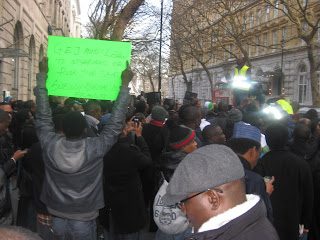
As you may know, the cost of petrol has more than doubled in Nigeria overnight due to the removal of the fuel subsidy. With little organisation, spontaneous protests have broken out all over the country. These protests have been dubbed OccupyNigeria by the twitterati and the name seems to have stuck. In solidarity with their brothers and sisters in Nigeria, today, Nigerians in the UK came to protest in front of the Nigerian High Commission on Northumberland Avenue.
Personally, I think there is some very sound, economical, common sensical thinking behind the removal of the fuel subsidy. However, I do support a peaceful protest and I'm always glad to see the Nigerians in diaspora uniting, so I went along to looku looku, take photos and report for you guys.
 |
| Protest when I arrived |
The event started at 12.30 and sources tell me that for once there was no African time. At 12.30, a sizeable crowd gathered to express their disapproval of Jonathan's policy. The atmosphere was festive but somewhat intimidating when I arrived at 1.30. I stood opposite the crowd, wondering whether to join them or pretend I was just a casual passerby. People were pushed right up to the barricades and I worried there would be a crush. Then I heard a trumpeter toot a line of, "Winner Ooo, Winner!" Nah my people nah. I crossed the road to join them.
 |
| Between the Barricades |
When I got between the barricades, I was relieved to see the crowd was not at dense as I had feared. Still the numbers were sizeable. A petition was going around which I declined to sign. A group to the left was chanting, "We no go gree o! We no go gree!" Everyone's phonetics was dropped for the day and to the left and right of me, I could hear heated conversations going on in Nigerian accented English. I saw people from my Church between the barricades. I saw my Muslim friend from Kings. I hung out with an Igbo journalist. It was Wazobia and all the languages in between.
 |
| Dele Momodu at Protest. Image Sourced from @DoubleEph |
Prior to my arrival, a former presidential aspirant showed up to speechify. Apparently his name had not been on the list of those to make speeches but once he arrived, he was given immediate priority. One disgruntled protester complained to me, "Now photos are going to go round and people will think Dele Momodu is pulling crowd in London." In his view, it would work to Mr. Momodu's political advantage to be shown speaking to a crowd he had done nothing to assemble. In fact, he even went as far as to suggest Mr. Momodu would gain economically from this. "Goodluck will phone him and ask what he should do to calm the people in London and he will now say, bring 50 million pounds." This statement is indicative of the level of distrust Nigerians have come to have for their government. We now see conspiracies and cabals everywhere.
I walked round and took some photos of the placards I saw.


There were camera crews hovering around and I recorded one woman venting her frustration at the government of Nigeria. Because they couldn't get their act together, Nigerians had to come abroad to be 'cleaning yansh' as she bluntly put it. She had come out to protest today because those in Nigeria, she believed, would be killed if they came out to do the same.
My favourite part of the event was wandering around and striking up conversations with strangers. I got accused of being a member of the Jonathan family. My patriotism was called into question. Everywhere discussions were springing up. I say discussion but a passerby might have thought heated argument. It was all in good cheer though. Shouting soon dissolved into laughter, handshaking and back slapping. I love my country people.
 |
| A protester making his point vehemently |
 |
| Camera crew |
I left when the protest was dying down. At the time I left, the Nigerian High Commissioner had still refused to receive the petition. His absence was irrelevant. The people had opened their mouths and discovered they could speak. My name is Chibundu Onuzo. God bless and good night.

Thursday, 8 December 2011
Know Your Rights

When Paul was arrested and flogged for preaching the gospel in Philippi, on his release the next day, he refused to leave the jail cell. He said to the officer sent to free him and Silas, 'They beat us publicly without a trial, even though we are Roman citizens, and threw us into prison. And now do they want to get rid of us quietly? No! Let them come themselves and escort us out.' (Acts 16:37) The magistrates who had ordered that they be flogged, had no choice but to agree to Paul's demand. You couldn't flog a Roman citizen without trial and get away with it. They were lucky Paul didn't ask for more.
Again, the bond servant Paul stood up for his rights in Jerusalem. Again he was flogged for preaching the gospel. The Bible says, 'As they stretched him out to flog him, Paul said to the centurion standing there, "is it legal for you to flog a Roman citizen who hasn't even been found guilty?" I love that he phrased this as a question, I love the calm brazenness of it, even as they were about to flog him, Paul was cool and questioning the centurion on a point of law. The commander who was superior to the centurion 'was alarmed when he realised that he had put Paul, a Roman citizen in chains." (Acts 23:25b,29b)
These two passages got me thinking. The only reason why Paul could claim his rights as a Roman citizen was because he knew them. As a Christian, I claim my spiritual rights when I pray. God has not given me a spirit of fear but a spirit of sound mind, God will not forsake the righteous and I am righteous by the blood of Jesus, God will bless me exceedingly, abundantly and above all that I can ask. But I could not tell you a single right that I have as a Nigerian citizen. I cannot tell you the rights I have as a Nigerian citizen living in the U.K. I have special rights that others do not have because I am a citizen of a Commonwealth country yet I do not know what these are. I cannot even tell you the rights that I have as a University of London student. The other day, I just discovered that I can order restricted documents from LSE because I go to Kings.
We Nigerians, we complain a lot but how many of us have ever sat down to read the constitution. I know I certainly haven't. So from today, I'm going to start trying to find out what I am entitled to and what my government owes me. If you want to join me, click here for the link to the Nigerian constitution. The website is not particularly attractive but the information is necessary. We can demand more effectively when we know our rights.
Wednesday, 19 October 2011
An Evening at Parliament

First of all, let me confess my ignorance in the midst of dear friends who won't hurl abuse at me. I got to Westminster station about twenty minutes before the event was due to start. Exit 3 said House of Parliament. My invite said House of Commons. Dear blog readers, I had a serious moment of panic. With not long to go before the meeting began, I became worried that the House of Commons and the House of Parliament were different places. Such are the gaps in my general knowledge. Thankfully they are the same place.
Before I found the meeting room, I walked and walked and walked. Every time I reach another desk with a police man I would ask, where is X room? They would reply, "Just straight down miss." Just straight down, straight down, up a few flights of stairs, straight down before I finally got to where I was going. I passed some busts of former Prime Ministers: Lord Palmerston, Gladstone, faces from my history books. As I walked to the room, my boots clicking on the stone floors, I kind of understood why people want to be powerful. There is something that feels good about striding down a long corridor, hearing your shoes click on the floor and feeling you are going somewhere important, you're rushing to a major decision that lives will hang on.
Now to the reason I was in the House of Commons in the first place. It was a meeting of The All Party Parliamentary Group on Nigeria and it was organised by Chatham House. No, I had never heard of this group of MPs from all parties who "aim to create a better understanding of issues relating to Nigeria; to promote links between Britain and Nigeria and to support development and democracy in Nigeria." Members of the group include Dianne Abott and Chuka Umunna.
There were three speakers. A Researcher on Nigeria from the Humans Rights Watch. The Detective Chief Inspector Economic and Specialist Crime Command, Metropolitan Police and Oba Nsugbe QC, SAN, Head of Chambers, Pump Court Chambers.
The researcher just didn't do it for me. Perhaps because he had limited time, he could only give an overview but unfortunately, a lot of what he mentioned could have been read on the Nigerian online newspaper, 234Next. The nadir for me though, was when he stated that in the past few weeks, the EFCC had arrested 3 governors. Immediately my ears pricked up. Three governors? No. They were EX-governors because the Nigerian constitution does not allow a sitting governor to be prosecuted. If the EFCC could prosecute current governors, then they could catch the criminals early instead of waiting for 8 years and billions of stolen Naira later. That a whole researcher on Nigeria could make this seemingly trivial error, didn't inspire confidence. Maybe the Human Rights Watch should hire some Nigerians to research about Nigeria. They might be able to get more inside gist.
The next speaker was from the Metropolitan Police. Immediately, I felt on this man's side. When he spoke of the trials of catching Nigerian crooked politicians, I really felt for him. He spoke of the case of Alamesiegha. They caught him at Heathrow with a suitcase full of hundreds of thousands of pounds in cash. They arrested him. He asked for bail. He wanted to return to Nigeria to sort out a few things. He said he would be back. They were not stupid. They knew he wanted to disappear. He said he would come back. At his hearing, the whole Attorney General of Nigeria left his duties to come and plead that Alamesiegha be allowed bail. Eventually, bail was posted at 500,000 pounds. It was paid without a blink. Alamesiegha has not been heard of since. The Met is doing better than EFCC. They have secured 15 convictions in 5 years whereas the EFCC has only secured 4 convictions of major political figures since its inception. Which is kinda pitiful. I was on the Met's side.
Then Mr. Nsugbe spoke. First of all, most of the money recouped from the Ibori cases and others of that ilk, isn't returned to Nigeria. I almost had a fit. I could not believe what I was hearing. Most of the money wasn't returned?! Where did it go? It first went to the Home Office, then to the Treasury, then the Met was reimbursed for the time they spent tracking down the criminal, then finally, at the discretion of Treasury, some, SOME of it, MAY go back to Nigeria. Of the 400 million dollars of looted Nigerian money that has been recovered abroad, most of it has not returned. Ladies and gentlemen, there is no charity in this world.
The man from the Met made his rejoinder. After all, sometimes they returned to money to Nigeria and nobody even bothered to cash the cheques. He told one story of how expired cheques were found in the Attorney General's top drawer. And of course, there was the worry that the returned money would just go back into corruption. No point chasing down laundered money, to chase down the same laundered money a few years later. But still, these arguments don't really hold water. If I leave my laptop lying around and it gets stolen, no-one has a right to tell me they won't give it back because they are worried I might be careless and it might get stolen again.
After this revelation, the audience was less than kind. One woman asked why the Metropolitan department that handled corruption was not expanded? After all, it was a profit making organisation (oooh low blow.) In the end, I agree with Mr. Nsugbe. There has to be a balance. The money should be returned but it should be monitored by a credible organisation. When 600 million dollars of Abacha's loot was returned to Nigeria, it's expenditure was monitored by the World Bank and thus, a lot of it was actually put to good use. But sha sha, these people should give us back our money, that's my own.
All in all, I enjoyed my 1 hour in parliament. All I had to do was register online. I didn't know anybody. I didn't need any connections. I wondered when I was leaving, if I could get into a meeting in the House of Senate with such ease in my own country. I doubt it.
Sunday, 9 October 2011
iRemember

I remember the hundreds that were trampled in the canal almost ten years ago. They were running from the bombs. Bombs that were exploding in the Ikeja cantonment. Nigeria was not at war, unless you count the criminal negligence of our politicians as a special, more subtle kind of war. A war of attrition where each side tries to wear the other down slowly and steadily. We will win. We outnumber them. Yet, how many more will die before they give in?
The bombs exploded because they overheated. They overheated because they were not cooled properly.They were not cooled properly because there had been no running water in the military barracks for years. There had been no running water because someone had pocketed the money for the piping system. One day a petrol tanker caught fire close to where the bombs were stored. The heat spread. The bombs began to explode.
GBOSA.
GBOSA.
GBOSA.
All over Lagos, people heard the noise and began to run. Those that were close to the bombs, those that were far from the bombs, they panicked and ran. They ran with their children. They ran with their merchandise. Some ran into the canal. A dirty brown waterway. Perhaps, those leading the charge stepped into the muddy waters and wanted to turn back. Once their feet touched the sludge, perhaps they came to their senses. What are we doing? Where are we running to? Why do we think that safety lies on the other side of this water?
But it was too late. Those behind were convinced that the bombs were right behind them. If they did not flee, they would die. And so they pushed them on, and others behind them pushed them on until people were stepping on bodies to cross the canal. A bridge of bodies. If you lost your footing, if you slipped on someones synthetic weavon, if you dared trip, you were clawed down and trampled. Those behind could not wait for you to find your feet again. Death was chasing them.
Over three hundred Nigerians died on that January 27th 2011. I saw the bombs flash red over the Ikeja night sky. I was there. iRemember.
P.S
Rest in peace Steve Jobs. You inspired us all.
P.P.S
Any comments on the new look for the blog?
Saturday, 24 September 2011
I See Lagos

I saw my first dead body in Lagos. I think I was 6. It was a man. If he had been alive, people would probably have called him a mad man. He had dreadlocks, matted and reddish brown from the sun. He was dressed in a long, grey, shirt rag. His body was beginning to swell on the side of the road. His mouth was open; a white paste spilled out of his lips.
We were on the way to school. My car zoomed past the sight, barely slowing down. I asked the driver what happened? He said the man had probably been run over while trying to cross the express at night. It was the military that had done it. He was certain. I could believe it.I always saw the soldiers zooming at fatal speeds in their black vans. If you got in their way, they could come down and flog you with their whips. Or if it was night and they were drunk, they would just run you over. I could imagine that they had not bothered to stop when they saw the man they had hit was just a mad man.
That was the Lagos I saw when I was growing up. Now Babatunde Raji Fashola (Senior Advocate of Nigeria) and Governor of the state I call home, is asking us to see a new Lagos. Like a pastor in church, he is asking us to speak what we want to see. O ye of little faith, speak what you want to see. The voice in the first clip says, "I see a Lagos where I can wake up by 7am after a good night's rest. Get to my train station by 7.30am, travel in comfort enjoying the beautiful scenery."
Like Sarah, I laughed when I heard what the man in this clip was seeing. The thought of someone in Lagos who lives on the mainland waking up at 7am and being on time for work seemed so preposterous that all I could do was laugh. O me of little faith. I had sat too long in third mainland bridge traffic to believe. Yet I am not so cynical that I cannot join my fellow Lagosians in this act of seeing a new Lagos. So here are the things I see in Lagos in the next few years. It may be a dream but the dreamers are often the most realistic of us all.
- I see a Lagos where there are no children swilling dirty soapy water over my car windscreen because they are all in school and the facilities provided for them there are world class.
- I see a Lagos where former agberos have acquired skills and gained employment . They are now pillars of their community, stressing the importance of education.
- I see a Lagos where affordable housing is made available for the millions living in shanty town conditions.
- I see a Lagos where graduates come out of university and face reasonable competition when looking for work.
That's the Lagos I see.
To find out more about the I see Lagos project, click here.
Friday, 26 August 2011
Someone Took the Money

Someone took the money,
That was supposed to buy the tools ,
To build the schools,
That would stop our youths from becoming fools.
Someone took the money,
That was supposed to pave the roads
To bring the jobs,
That would sate the mobs.
Someone took the money,
That was supposed to light our streets,
And ease the load,
Of investors wishing to turn cash to gold.
Someone took the money,
That was supposed to train the men,
To stop the bombs,
And terrorist guns.
Someone took the money,
Because they were too shortsighted,
To read the sign:
CONSEQUENCES CAN ONLY BE PUT OFF FOR A TIME.
Saturday, 23 July 2011


Saturday, 18 June 2011
Sirens

You see, a big man cannot wait in traffic like the rest of us. Even when the most pressing matter on his plate is to go home and cut his finger nails, he still cannot wait in traffic like the rest of us. Come on, can't you see how demeaning that is. A whole big man, sit in his air conditioned car and actually wait to get somewhere. No. Abomination. Switch on that siren now! And it's funny, the Nigerian psyche has been so brutalised by decades of military rule that no-one questions what right this big man has to turn on his siren and force a way through traffic. It's amazing. Once people hear the siren, almost as if by magic, a way begins to be made in the most gridlocked traffic. It is like watching a modern parting of the Red Sea.
Last week, I was sitting on third mainland bridge when one of these big men decided to switch on his siren. The driver taking us home is a rather strong headed individual and he refused to stop or clear to the side for them to pass. That is, until the armed guards in the big man's convoy got out of their vans and began to bang people's cars, telling them to stop and move to the side. Of course the driver stopped after that. Who wan die? As the convoy drove past, I saw the number plate of the main vehicle. It said ADMIRAL 1. If I had a stone on me, I would have hurled it at that car and probably been arrested for attempted murder, like the unfortunate hawker who threw a sachet of Pure Water at a governor's convoy. Thankfully, there was no stone and so I am not typing this from Kiri Kiri maximum security.
As the convoy passed, the driver said, "They didn't born us properly. That's why we must sit in traffic." It's true. We were the one's that were born with one head while they were born with two. That's why a big man cannot queue in this country anymore. For goodness sakes, where are the dividends of democracy, those thieving politicians are always talking about. You mean after a dozen years of having the vote, I still have to clear road because an Admiral is passing? Are we at war with anybody? Is he rushing to command a fleet? If not, he'd better sit in traffic like the rest of us.
The Governor of Lagos State, Babatunde Raji Fashola, is famously known for not using a siren when he moves about Lagos. As I have heard him say in an interview, "Sirens are for emergencies. Using one when I move around implies that we are constantly in a state of emergency in Lagos. Which we are not." Unfortunately, B.R.F is leading by example and we all know how famously bad Nigerian leaders are at following good examples. It's about time someone started legislating against this big man syndrome that expresses itself in the unnecessary use of sirens.
I know out of all the problems that face Nigeria, you may think that sirens are the most insignificant but I beg to differ. They are the most visible sign of the culture of impunity that exists among our big men and leaders. A culture that says I am not subject to the same laws as everybody. That's why they steal, that's why they kill, that's why they inflate contract prices. When sirens start getting silenced, other illegal practices may soon follow the same fate.
Saturday, 26 March 2011
Thursday, 17 March 2011
Girl Power

This should be interesting. Chimamanda to moderate presidential debate. Let's hope she fires them well well. Read more here.
Monday, 14 March 2011
Change Gonna Come?
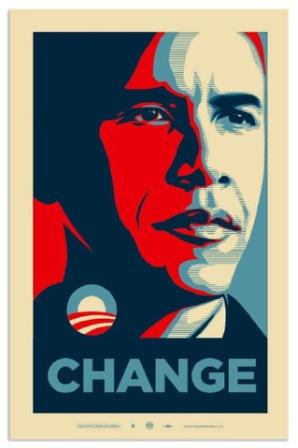
I just watched about 45 minutes of the Nigerian V.P debate (YouTube didn't have the rest) and my reactions are a little mixed. No doubt I enjoyed it. The candidates were well spoken, humorous at times and they offered their soundbites with a gravitas and sincerity that you don't encounter often in Nigerian politics. But at the end of the day, I couldn't escape that despire the packaging being more refined, I'd basically heard many of the statements before. Fighting corruption, we've been kung fuing the thing since 1999. Providing jobs, that one isn't exactly new either.
Also, there was a lot of PDP bashing and though some of it was very entertaining I felt that the candidates really lost an opportunity to expound on their policies by focusing so much on the ruling party. I wish somebody had said this is not about what the PDP hasn't done for you, this is what my party is going to do for you and this is how we are going to do it. One argument of course is that in such a debate, given that you have between 30 and 60 seconds to answer a question, there's not much time to expound on your policies but they didn't seem to have any problem summarising their vitriol against the PDP. At the end I knew what all three were against (PDP) but what exactly were they for? However, as I've said the PDP bashing was entertaining and here are some of the best instances of this.
"Great nations are not built on good luck." Pastor Tunde Bakare (CPC)
"Those who the gods want to kill they first make mad." Fola Adeola on the PDP. (ACN)
"I'm not concerned about the fanfare. It's a farewell party that PDP is having across the nation." Tunde Bakare on PDP's campaign.
"Flamboyant campaigns that look like beauty pageants." Chief Oyegun on PDP's campaign. (ANPP)
And my personal favourite just because its directness is almost sarcastic:
"The PDP are wicked. Get them out." Fola Adeola.
Unfortunately the PDP Vice Presidential candidate did not attend. And of course this was another opportunity for more bashing. Words like impunity, impudence and travesty were thrown around.
This is not to say that the candidates didn't have concrete policies.
"Amend the Constitution to remove immunity from prosecution from elected officers in criminal cases." Pastor Tunde Bakare on corruption. (CPC)
That however was the only concrete procedure I jotted down. I know there were more, Pastor Tunde Bakare talked about going back to a less oil based economy by developing agriculture, Chief Oyegun mentioned how religious violence had been practically combated in Kano State (the state where his principal was from) but all in all, I just got a sense of vagueness when it came to policies. When asked about corruption, the ACN candidate gave a proverb that says a fish spoils from the head so if he and his principal refuse to be rotten then their subordinates would follow their lead and so on and so forth. To me that just didn't seem concrete enough. The general vagueness of the debate was best exemplified in this statement about the Niger Delta made by Fola Adeola:
"Where there is no justice there is no peace."
It sounds good and it's certainly true but I would have preferred more concrete figures. What percentage of the budget are they going to devote to reversing the injustices done in the Niger Delta? How are they going to rehabilitate militants into society? What are the key issues they have identified in the area that if addressed will reduce tension drastically? Nothing on that from any of the candidates I'm afraid. Nothing.
I'll leave you with this and these were my final thoughts on the debate. Former military ruler and CPC presidential candidate Mohammed Buhari was purported to have said, Nigerians should go out and 'defend their votes.' Now what he meant by that was unclear, so the moderator (who was a good blend of forcefulness and charm) asked Pastor Bakare to clarify. He at first made matters murkier by alluding to the situations in North Africa without actually explaining if 'defend your vote' meant, defend your vote with violence. He then gave a closer to home example of this defence by narrating the story of what happened during a state election. Apparently, the people who manned the ballot boxes were surrounded by men with kegs of kerosene and matches in their hands so basically, there was no chance of a rigging.
This anecdote meant to inspire left me a little confused. Taking pictures of the voting process with your phone and not leaving the voting station until they have counted the votes all this is very well and good and I agree with this, but turning up with a keg of kerosene and box of matches at a polling station, surely this is just another example of the do or die politics that PDP is famous for.
Scenario 1:
There are men at the polling station with machetes, stopping me from casting my vote.
Scenario 2:
There are men at the polling station with kegs of kerosene protecting my vote.
Both situations look frighteningly similar to me. Both situations would make me consider staying at home on polling day and padlocking my gate. To be fair, the other two candidates were not as drastic in defining what they meant by defend your vote but I wish at least one would have stated clearly that their definition was exclusively non-violent. Arguably, Pastor Bakare's definition depends more on the threat of violence than actual violence but the election season is volatile enough.
And it's no good saying that the PDP have historically used violence in their election campaigns because you don't fight fire with fire as any fireman will tell you.
So in short, these are my thoughts on the VP debate. Watch it for yourself.
P.S
It was a shame that Vice President Sambo didn't show up because the three candidates might not have been so chummy otherwise. They were so united in their disgust for the PDP, they might have belonged to the same party, a point the moderator brought up.
P.P.S
The audience was too scanty.
Subscribe to:
Posts (Atom)
